


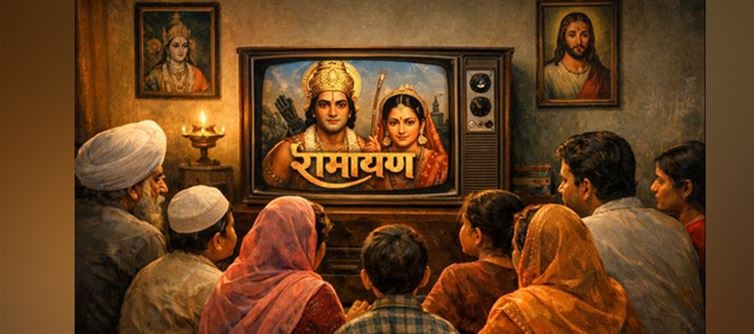

Once upon a time, india paused—together. Streets went quiet, neighbours gathered, and televisions became windows to a shared myth, a shared morality, and a shared silence. Ramayan and Mahabharat weren’t propaganda tools or identity tests. They were television events—gentle, patient, and inclusive—crafted by Ramanand Sagar and B. R. Chopra to tell ancient stories with modern restraint. No shouting. No labels. No enemies. So what changed after 2014, when faith stopped being felt and started being forced?
1) When television Was a temple of Togetherness
In the ’80s and ’90s, families didn’t “identify” with these shows—they experienced them. Hindus, Muslims, Christians, Sikhs sat in the same rooms, watched the same episodes, and took the same moral lessons home. Nobody asked who you were. Only whether you understood dharma, duty, and compassion. religion was context—not a contest.
2) Faith as Story vs. Faith as Statement
Back then, Ramayana and Mahabharata were treated like literature on screen—epic narratives with philosophy, tragedy, doubt, and moral ambiguity. Today, religion is increasingly framed as a declaration of loyalty. Stories that once invited reflection are now used to demand alignment. Meaning shrank; volume exploded.
3) Entertainment Turned into Identity Proof
Earlier, watching these serials didn’t certify your beliefs. It didn’t place you on a side. It didn’t invite surveillance. Post-2014, faith in popular culture often comes with instructions—what to feel, who to blame, who belongs. The joy left the room; anxiety moved in.
4) From Values to Vibes
The old serials preached restraint, forgiveness, duty, and consequence. Today’s discourse prefers rage, certainty, and instant verdicts. Values take time; outrage travels faster. Somewhere along the way, moral nuance was replaced by political convenience.
5) When Forcing Faith Backfires
Ironically, the harder religion is pushed as ideology, the faster people recoil from it. Many Hindus today feel alienated—not from their faith, but from the version being marketed. Faith thrives in freedom. Coercion turns belief into a burden.
6) social media Rewrote the Script
Sunday mornings once unified households. Now timelines divide them. Algorithms reward extremes, not empathy. What was once a collective ritual is now individual performance—loud, defensive, and perpetually angry.
7) religion Was Never Meant to Be the Core
Faith was once a compass, not an identity card. A guide, not a gate. When religion becomes the core of political identity, it stops healing and starts harming—believers included.
The brutal truth
Ramayana and Mahabharata didn’t radicalise India.
They humanised it.
What changed wasn’t the stories—it was the intent with which they’re invoked. When faith shifts from personal meaning to public weapon, everyone loses. Especially the religion itself.
The real takeaway
india didn’t grow more religious after 2014.
It grew more insecure about religion.
And maybe the most radical thing today would be to return to how it once was:
Quiet. Optional. Shared.
Where gods lived on screens—and humanity lived in the room.
 click and follow Indiaherald WhatsApp channel