



Four Days at Isha — And the Questions That Got Me Removed
I went to the Isha Centre for a four-day yoga program expecting structured practices, discipline, maybe even clarity. What I didn’t expect was how quickly the focus would shift — not just to yoga, but to building an image.
From day one, the instructors worked to establish one central idea: Sadhguru is not just a teacher. He is an extraordinary yogi. A master of all yogic sciences. Someone who simplified complex spiritual truths for humanity. A being whose very presence is a blessing.
Whether he was physically there or not didn’t matter. His name framed every activity. Every instruction carried his authority. Even in his absence, his presence felt carefully maintained — almost designed to settle into your mind without resistance.
Slowly, you begin thinking: What an extraordinary guru.
1️⃣ Emotional Engineering in the Name of Awakening
There was a viral video once of actor Dhamu making schoolchildren cry during a speech. The technique looked familiar.
We were told to close our eyes and think of someone we loved deeply. Imagine their affection. Soft flute music played in the background.
The voice guiding us grew more emotional. Then suddenly, the tone shifted. The music turned somber.
“Your loved one has passed away.”
Ask for forgiveness. Admit your mistakes. Cry if you must.
And people did.
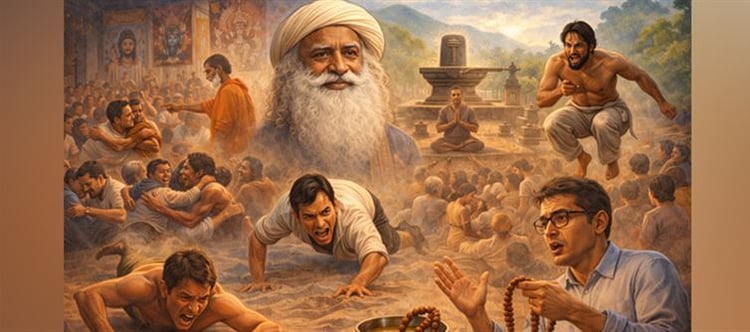
Strangers hugged strangers, sobbing. Grown adults weeping into the shoulders of people they had met only hours ago. One man came toward me, saying, “Forgive me,” as if I were his wife.
I pushed him away. This wasn’t enlightenment. It felt like emotional manipulation.
2️⃣ The Samyama Spectacle
We were told that an eight-day Samyama program could cleanse karmic baggage accumulated across lifetimes. It was presented as the ultimate spiritual leap — conducted directly by Sadhguru himself.
To show us what transformation looked like, they pointed to a group of past participants.
One man was crawling like a snake. Another leaping like a monkey. Someone else is barking like a dog.
“What is this?” I asked.
We were told these were past-life impressions resurfacing. Samyama had unlocked memories of their previous births. After the program, they would return to normal.
That explanation didn’t reassure me. It unsettled me.
3️⃣ The Myth of the Sleepless Guru
Another claim floated confidently: Sadhguru doesn’t sleep.
Apparently, there’s a secret yogic method known only to him. Five minutes of this special sleep equals ten hours of rest. That’s why he can dance all night energetically, they said.
It sounded less like yoga and more like mythology.
4️⃣ The Rudraksha Rituals
We were encouraged to buy a Rudraksha mala. It would create an aura around us. Protect us. Elevate us.
Price? Around ₹1,000.
But that wasn’t enough. It had to be soaked in ghee. Then in milk. Only then would its energy activate.
A doctor attending the course tried explaining the body’s motor functions during one discussion. He was reportedly removed the same day.
Confidence is powerful. Demonstrating belief in front of hundreds requires nerve. But belief alone doesn’t make something true.
5️⃣ When Questions Become Offences
There was a Q&A session.
We were told yoga transcends religion — that it belongs to all humanity. But the rituals on display closely mirrored Hindu worship practices. Shiva. Krishna. Traditional poojas.
When I asked why a supposedly religion-neutral system leaned so heavily on Hindu symbolism, the answer was:
“Shiva is not a god. He is Adiyogi.”
That wasn’t my question.
If yoga is beyond religion, why replicate religious ritual structures? That’s all I wanted clarified.
I was asked to leave the same day.
6️⃣ The Memory I Don’t Remember
Months later, I met someone from that program.
He laughed and said, “Do you remember? After they taught us that all life is equal, they played Bharathiyar’s ‘Uyire Ninathu Perumai’ in bombay Jayashri’s voice. You were looking at flowers and grass, crying, calling them your little calves.”
I have no memory of that.
That day itself feels blurred. Fragmented. I don’t recall weeping at flowers — though it would take a poet’s heart to cry like that.
The Larger Question
Was it devotion? Suggestibility? Group psychology? Emotional catharsis? Faith?
Maybe for some, it was transformative.
For me, it raised more questions than answers.
Spiritual spaces can inspire. They can also persuade. The line between guidance and psychological influence is thinner than we admit.
I went looking for yoga.
I left wondering whether I had witnessed spirituality — or theatre wrapped in belief.
 click and follow Indiaherald WhatsApp channel