



The strike That May Have Blinded America’s Watchtower in the Gulf
In modern warfare, information is everything. Radar systems, satellites, and surveillance networks act as the nervous system of military power — spotting threats long before they arrive. Which is why the latest development in the escalating confrontation involving the united states, Israel, and iran is raising alarms across defense circles.
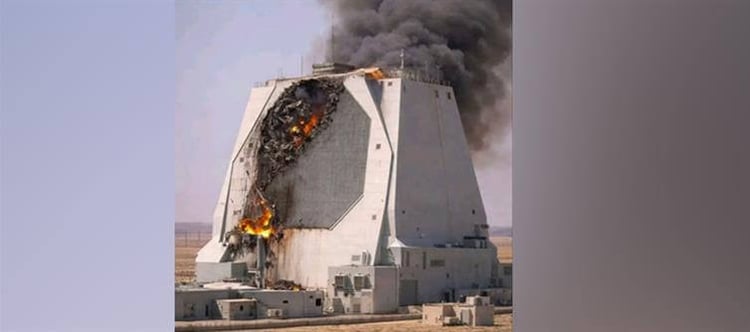
Iran’s Islamic Revolutionary Guard Corps says it struck and destroyed one of America’s most important early-warning radars in the gulf — a massive system worth $1.1 billion, capable of tracking ballistic missiles across 5,000 kilometers.
If the claim proves accurate, it would mean that one of Washington’s most powerful surveillance assets in the region has just taken a direct hit.
And the implications could be enormous.
1. The Radar That Watched the Entire Middle East
The radar in question is the AN/FPS-132, deployed at Al Udeid air Base.
This isn’t just any radar.
It’s one of the most advanced early-warning systems in the US military arsenal — designed specifically to detect and track ballistic missile launches across vast distances.
With a detection range of roughly 5,000 kilometers, the system can monitor missile activity across almost the entire Middle East.
From iran to the eastern Mediterranean, it acts as a massive electronic lookout tower scanning the skies.
2. A Billion-Dollar Shield
The radar system reportedly cost around $1.1 billion to build and deploy.
Its job is simple but crucial: detect missile launches early enough to give military forces time to respond.
Once a launch is detected, the radar feeds targeting and trajectory data into US missile defense networks — allowing systems such as interceptors and regional defenses to prepare for incoming threats.
In other words, it’s one of the key components in the US effort to protect bases, allies, and strategic assets across the Gulf.
3. Iran’s Claim: A Direct Missile Strike
According to Iran’s Islamic Revolutionary Guard Corps, the radar array was targeted in a missile strike carried out near Al Udeid air Base.
The Guard says the strike destroyed the radar installation — a claim that, if verified, would mark one of the most significant direct attacks on US military infrastructure in the region in years.
Images circulating online reportedly show heavy damage to the radar array structure.
However, independent confirmation of total destruction remains unclear.
4. What qatar Has Confirmed
Officials in Qatar have acknowledged that missiles struck areas around the base and that there were impacts and injuries.
However, details about the exact condition of the radar system remain limited.
Meanwhile, the United States Central Command has not officially confirmed whether the radar system has been completely destroyed or only damaged.
For now, the battlefield narrative is still evolving.
5. Why This System Matters So Much
Early-warning radars are not just surveillance tools.
They are the backbone of missile defense.
Without them, reaction times shrink dramatically.
That means:
• less time to track launches
• less time to calculate trajectories
• less time to activate interceptors
In a region where ballistic missiles are a central part of military strategy, losing a radar like this — even temporarily — would represent a serious operational setback.
6. A war That May Only Be Beginning
The strike comes amid a widening confrontation tied to ongoing US and Israeli operations targeting Iranian military capabilities.
Former US president Donald Trump has indicated that the campaign — referred to as Operation Epic Fury — could continue for four to five weeks or longer.
The stated objective: degrade Iran’s missile infrastructure, nuclear facilities, and naval assets.
trump has also suggested that no option is fully off the table, including the possibility of broader military escalation if necessary.
7. The Dangerous Escalation Spiral
Striking surveillance infrastructure marks a new level of escalation.
Radar systems are not symbolic targets — they are strategic nodes in the military command chain.
Hitting them sends a clear message: the conflict is moving beyond limited skirmishes toward deeper strategic confrontation.
Every destroyed radar, missile battery, or command center raises the stakes.
And in a region already packed with military bases, missile systems, and fragile alliances, even a single strike can ripple across the entire geopolitical landscape.
The Bottom Line
For years, the radar at Al Udeid quietly scanned the skies above the Middle East, watching for the first hint of incoming missiles.
Now it may have become a target itself.
Whether the system has been completely destroyed or only damaged remains uncertain.
But one thing is clear.
The war of shadows between the united states and iran is no longer staying in the shadows.
And every new strike pushes the region closer to a much bigger confrontation.
 click and follow Indiaherald WhatsApp channel