


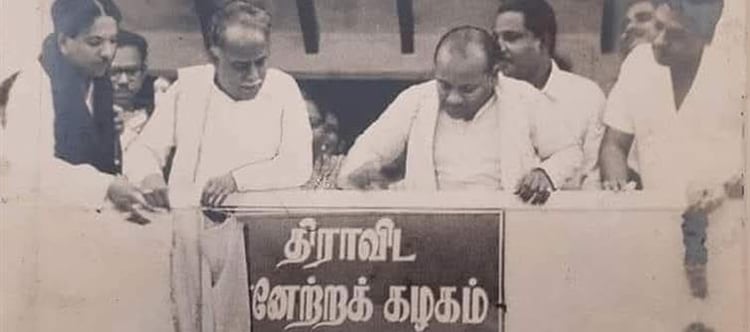

Why DMK Never Seems to Disappear
In politics, most parties eventually fade. Some collapse under pressure. Some dissolve after losing elections. Others simply vanish when leadership changes.
But the Dravida Munnetra Kazhagam (DMK) has defied that pattern for more than seven decades.
Since its birth in 1949, the party has been declared finished countless times. Opponents predicted its collapse, rivals mocked its ideology, and critics repeatedly said its influence would fade.
Yet election after election, decade after decade, the DMK keeps returning to the center of tamil Nadu politics.
To understand why, you have to go back to where it all began.
1. The First Test: Entering the assembly in 1957
The DMK was founded in 1949, but it took nearly a decade before it stepped into electoral politics.
Its first major test came in the 1957 tamil Nadu (then madras State) assembly election.
At the time, the political landscape looked very different.
The Indian National Congress was the ruling party.
K. Kamaraj served as Chief Minister.
The Communist Party was the main opposition.
Into this crowded political arena stepped the DMK — a new movement still building its identity.
In that first election, the party managed to win 15 seats.
For a brand-new political force, it was a small but significant breakthrough.
2. Fifteen Voices That Changed the Assembly
Those 15 DMK legislators quickly made their presence felt inside the Assembly.
Their speeches were sharp, witty, and relentless. They were known for coming prepared, often armed with facts, arguments, and quick rebuttals.
If ministers offered an answer, DMK members followed it up with a barrage of questions.
What made their style unique was their ability to combine politics with satire and cultural references.
Even though they were often labelled atheists, many of them had deep knowledge of Hindu scriptures and classical literature. They would quote from epics and puranas in debates — sometimes to make political points, sometimes to deliver biting satire.
The result?
Even the ruling party members who were being criticized would occasionally end up laughing in the Assembly.
3. The Demand That Angered the Establishment
Among the DMK’s most persistent demands at the time was a symbolic but powerful one.
They wanted the name “Madras State” to be changed to “Tamil Nadu.”
To the DMK, this was about identity — language, culture, and regional pride.
But to many national leaders at the time, the demand sounded dangerously close to regional nationalism.
Chief minister Kamaraj reportedly grew increasingly frustrated with the DMK’s constant emphasis on Tamil identity, Dravidian politics, and regional pride.
From his perspective, it looked like divisive politics.
4. Kamaraj’s Prediction
At one point, Kamaraj is said to have made a bold prediction about the DMK.
He argued that the 15 MLAs who had entered the assembly would not return in the next election.
In fact, he predicted that not even one of them would win again.
And he went further.
He declared that the DMK would eventually become the only real rival to the congress in tamil Nadu politics.
At the time, that statement sounded almost contradictory — predicting both their defeat and their rise as a rival.
5. The 1962 election Surprise
When the 1962 assembly election arrived, Kamaraj’s prediction seemed partly correct.
Out of the original 15 DMK legislators, 14 lost their seats.
Even C. N. Annadurai (Anna), the party’s founder and leader, was defeated.
Only one of the original fifteen survived electorally.
That man was M. Karunanidhi, later known simply as Kalaignar.
But here’s where the story takes an unexpected turn.
Karunanidhi did not return alone.
6. From 15 to 50
Despite the defeat of many early leaders, the DMK actually expanded its presence dramatically.
Instead of shrinking, the party entered the assembly with around 50 members.
In other words:
The party that started with 15 seats had suddenly grown into a major political force.
By the time of its second major electoral test, the DMK had already become the principal opposition party in tamil Nadu.
Kamaraj’s prediction turned out to be strangely accurate.
The DMK did emerge as the Congress’s main political rival.
7. The Long List of Rivals
From that moment onward, tamil Nadu politics entered a new phase.
Every decade produced new rivals who claimed they would defeat or destroy the DMK.
The list of critics and challengers grew long over the years — leaders, parties, and movements that rose to prominence at different times.
Some of them were former allies.
Some were ideological opponents.
Some were entirely new political forces.
Yet through all these shifts, the DMK remained a constant presence in the state’s political landscape.
8. The Pattern That Never Changed
Over time, a pattern began to emerge.
New parties would rise with energy and momentum.
They would declare themselves the true alternative.
They would promise to end the DMK’s dominance.
But tamil Nadu politics kept evolving, and those challengers often faded or transformed.
Meanwhile, the DMK continued adapting — changing leadership, adjusting strategies, and building alliances when necessary.
The Reason DMK Keeps Surviving
The survival of the DMK isn’t simply about winning elections.
It’s about something deeper.
The party built its identity around language, regional pride, social justice, and political debate. Those themes became deeply woven into tamil Nadu’s political culture.
And once a movement becomes part of a state’s political DNA, it becomes extremely difficult to erase.
The Political Reality
For more than 70 years, countless opponents have predicted the end of the DMK.
But the story of the party has followed a different script.
Leaders changed.
Rivals emerged.
Political tides shifted.
Yet the DMK kept finding a way to remain relevant.
And if history is any guide, the long line of people predicting its downfall may continue to grow — long before the party itself disappears.
 click and follow Indiaherald WhatsApp channel