



Everyone talks about oil. Few talk about who actually controls what happens after it’s pumped. That’s where the real power sits. And right now, that power is shifting fast, loud, and decisively toward Asia.
Start with India. The Jamnagar refinery isn’t just big, it’s on another scale entirely. Processing around 1.24 million barrels a day, it stands as the largest refining complex on the planet, a giant that quietly fuels economies far beyond its borders. It’s not just infrastructure, it’s influence.
Then comes Venezuela’s Paraguana complex. Once the pride of Latin America’s oil dominance, it still holds massive capacity at roughly 940,000 barrels per day. But unlike Jamnagar, its story is complicated, weighed down by instability and underinvestment. Size alone doesn’t guarantee control.
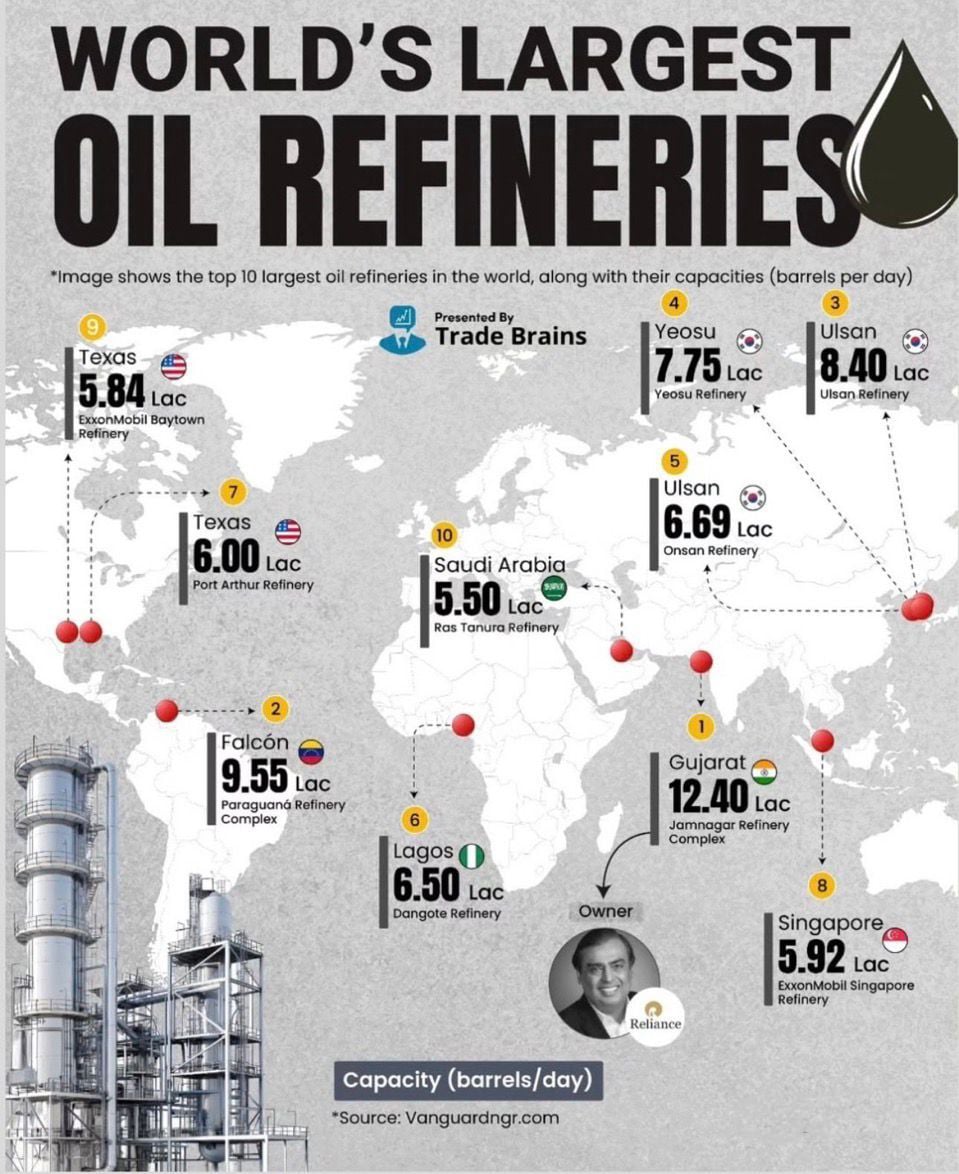
Now look at South Korea. This is where things get serious. Ulsan and Yeosu aren’t just refineries; they are precision machines built for efficiency and exports. Ulsan pushes around 840,000 barrels daily, while Yeosu adds another massive chunk to the global supply chain.
Together, they signal something bigger. Asia isn’t just consuming energy anymore; it’s refining, exporting, and dictating flow.
And then there’s the United States. Yes, texas still hosts some of the largest refineries on earth. But the narrative has shifted. The dominance is no longer absolute. It’s shared, challenged, and increasingly outpaced in scale and growth.
This is the uncomfortable truth. oil power is no longer just about reserves underground. It’s about what you can process, how fast you can move it, and who depends on you when things go wrong. And right now, the center of that gravity is moving steadily, strategically, and without apology.
 click and follow Indiaherald WhatsApp channel