
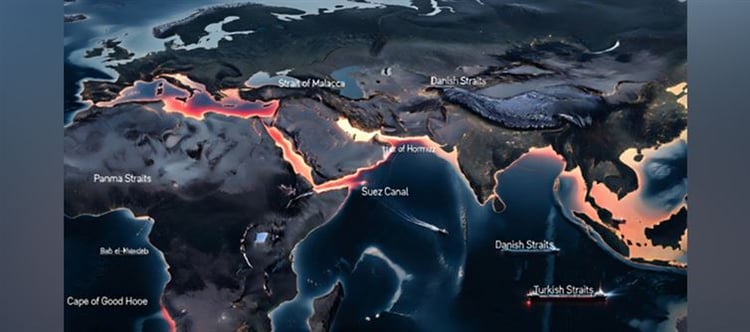


Here’s the uncomfortable truth about global energy: it doesn’t just depend on how much oil the world produces — it depends on where that oil can pass through. And right now, a massive share of the world’s supply is funneled through a handful of narrow, vulnerable chokepoints.
Take the Strait of Malacca. Every single day, over 23 million barrels of oil squeeze through this tight corridor between malaysia and Singapore. That’s not just traffic — that’s a lifeline for Asia. Close it, even briefly, and supply chains across India, China, and beyond start feeling the heat almost instantly.
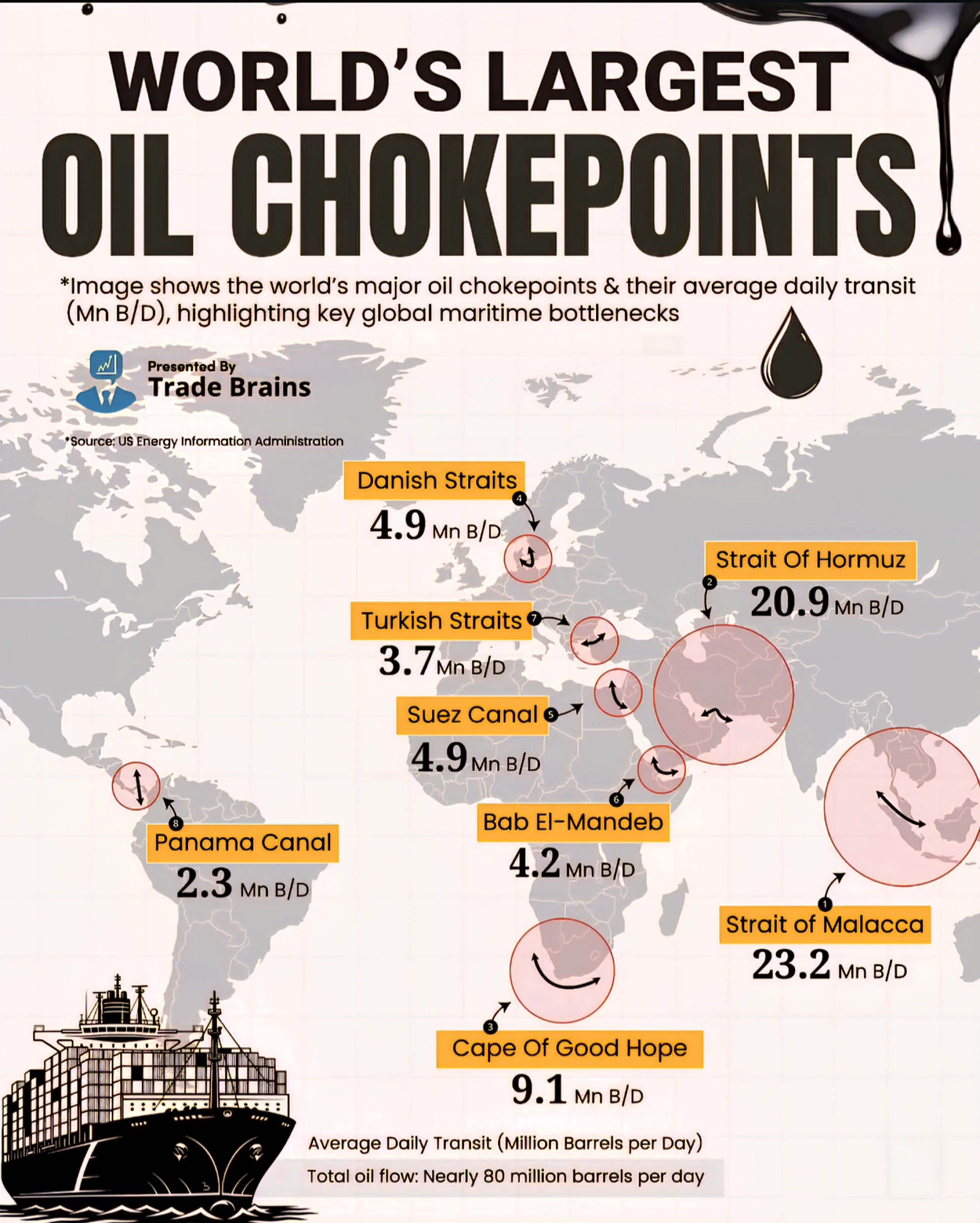
Then there’s the Strait of Hormuz — the geopolitical pressure valve of the oil world. Nearly 21 million barrels pass through it daily. Any tension here doesn’t stay local; it sends shockwaves across global markets within hours.
Further down the list, routes like the Suez Canal, Bab el-Mandeb, and the Turkish Straits may carry smaller volumes, but they are no less critical. Each one is a potential flashpoint. A disruption in any of them — whether due to conflict, piracy, or accidents — can tighten supply, spike prices, and trigger economic ripple effects far beyond their geography.
And that’s the bigger picture. Out of roughly 80 million barrels of daily global oil flow, a huge portion depends on just these few narrow passages. It’s a system built on efficiency — but also on fragility.
Because when the world runs on oil, and oil runs through chokepoints, even a small blockage can turn into a global crisis.
🌍 World’s Largest oil Chokepoints
| Rank | Chokepoint | Location | Daily Flow (Mn B/D) |
|---|---|---|---|
| 1 | Strait of Malacca | Malaysia–Singapore | 23.2 |
| 2 | Strait of Hormuz | Oman–Iran | 20.9 |
| 3 | Cape of Good Hope | South Africa | 9.1 |
| 4 | Danish Straits | Denmark | 4.9 |
| 5 | Suez Canal | Egypt | 4.9 |
| 6 | Bab el-Mandeb | Yemen–Djibouti | 4.2 |
| 7 | Turkish Straits | Turkey | 3.7 |
| 8 | Panama Canal | Panama | 2.3 |
Note: Figures represent average daily oil transit in million barrels per day.
 click and follow Indiaherald WhatsApp channel