


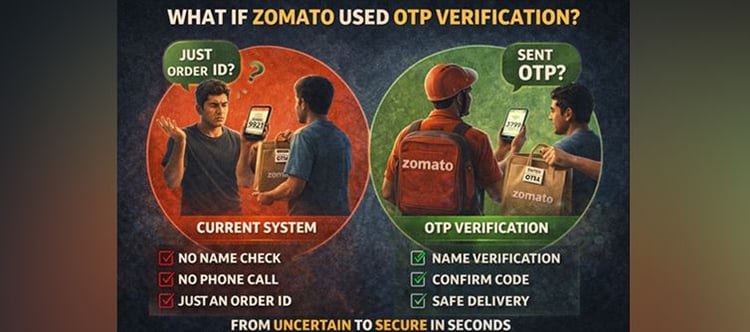

🍔 “Order Delivered.” Food Missing. Trust Broken. Why zomato Needs OTP Verification—Now.
It was late.
I was hungry.
The order was already 30 minutes late, which itself raised eyebrows.
Then came the punch to the gut—not metaphorical, very real.
“Order delivered.”
No doorbell.
No phone call.
No message.
Just a cold notification declaring dinner successfully completed—without dinner ever arriving.
This isn’t just a bad delivery story.
This is a system failure. And Zomato needs to fix it.
⚡ The Incident That Exposes the Loophole
When I rushed downstairs, confused and irritated, the order was already marked delivered.
I called the delivery partner.
No answer.
I contacted customer care immediately. To their credit, they arranged a conference call between me, the delivery partner, and support.
That’s when the explanation came—one that should alarm every zomato user.
🧨 “He Told Me the Order ID.”
The delivery partner claimed he handed the order to a random boy in my colony because the boy quoted the order ID.
Let that sink in.
No name verification
No phone call
No confirmation
No face match
Just an order ID—which, by the way, is often printed on the delivery bag itself.
By that logic, anyone standing near a gate can collect your food.
🧠 The Obvious Question Nobody Answered
If this was truly a mistake, it was negligence.
If it wasn’t, it was something worse.
Either way, the customer has zero protection.
There is no wallet PLATFORM' target='_blank' title='digital-Latest Updates, Photos, Videos are a click away, CLICK NOW'>digital handshake.
No final confirmation.
No accountability checkpoint.
The system runs on assumptions—and assumptions don’t feed hungry people at midnight.
🔐 The Missing Piece: OTP Verification
This entire mess could have been avoided with one simple step:
OTP-based delivery confirmation.
Used by:
Courier companies
Ride-hailing apps
Banks
Even grocery deliveries
But somehow, hot food worth real money is handed over on trust alone?
An OTP would mean:
No fake handovers
No “wrong person” excuses
No customer anxiety
Clear accountability
🚨 The Refund Came… With a Threat
Yes, customer care refunded the amount.
But then came the line that stung harder than the hunger:
“This is the first and last time.”
Excuse me—last time for what?
Last time your system failed?
Last time a delivery partner made an unverifiable claim?
Last time I trusted your platform?
Why is the customer being warned about a problem caused by process gaps?
And what happens if this repeats?
No refund?
No food?
Just silence?
⏳ The Real Cost: Time, Trust, and Dignity
This wasn’t just about money.
My time was wasted
My night was ruined
I ended up with nothing to eat
And I was made to feel like I was at fault
That’s not customer support.
That’s customer intimidation.
🛠️ Fix the System, Don’t Scold the User
Platforms scale fast.
Trust does not.
If zomato wants to retain credibility, it needs to:
Introduce OTP-based delivery confirmation
Protect customers from repeat incidents
Stop issuing warnings instead of solutions
Build systems that assume failure—not blind honesty
🏁 Final Word
Food delivery is no longer a luxury—it’s infrastructure.
And infrastructure must be verifiable, fair, and customer-first.
Refunding money is damage control.
Fixing the loophole is a responsibility.
Until zomato introduces OTP verification, every “Order Delivered” notification comes with a question:
Delivered to whom?
 click and follow Indiaherald WhatsApp channel