


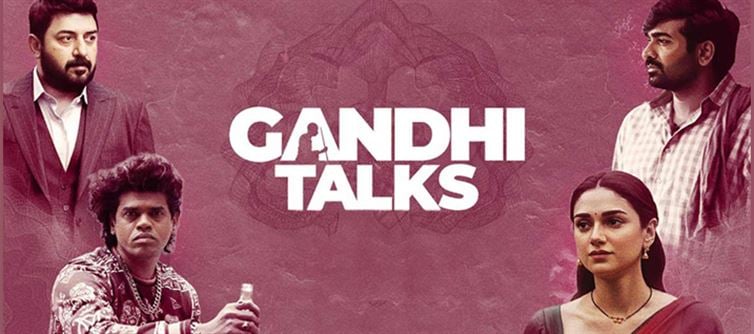

A Bold idea Wrapped in Silence
With Gandhi Talks, director Kishor Pandurang Belekar attempts something audacious in contemporary indian cinema: a full-length silent film set in modern Mumbai. It’s an experiment that positions money — emblazoned with mahatma Gandhi’s face — as the loudest voice in society. The ambition is undeniable. The execution, however, wavers between inspired and indulgent.
Story: Money Talks, people Don’t
Set in Mumbai’s contrasting worlds, the film follows Mahadev vishnu Kumar (Vijay Sethupathi), an unemployed man living in a chawl with his ailing mother, and Mohan Boseman (Arvind Swami), a polished entrepreneur crushed by personal and professional loss. Their lives intersect through a morally murky scheme involving a pickpocket, triggering a chain of events rooted in greed, desperation, and power.
The film’s most striking sequences use silence as social commentary: a judge “typing” justice influenced by currency, politicians distributing money instead of speeches, and job interviews where tea replaces conversation as shorthand for bribery. The message is clear — Gandhi’s ideals adorn the currency, but cash speaks louder than conscience.
Performances: Eyes, Expressions, and Restraint
If Gandhi Talks works at all, it’s because of its lead performances. vijay sethupathi brings remarkable vulnerability to Mahadev, communicating despair, dignity, and suppressed rage through micro-expressions alone. Arvind Swami is equally compelling, embodying controlled grief and moral erosion with quiet precision.
Their scenes together are the film’s emotional backbone. Even when the narrative falters, their presence keeps the audience anchored. Supporting turns, including Aditi Rao Hydari as Mahadev’s neighbour and siddharth Jadhav as the pickpocket, add warmth and texture, though they too are constrained by the film’s rigid silence.
Direction & Craft: Silence as Statement — and Stubbornness
Belekar’s commitment to silence is unwavering, almost defiant. The film uses onscreen text, symbolic actions, and carefully staged tableaux to convey meaning. At its best, this creates striking visual metaphors. At its weakest, it feels like silence for silence’s sake.
The problem isn’t that characters don’t speak — it’s that the film never justifies why they don’t. Lovers don’t whisper. Men don’t shout in anger. Pain remains unvoiced even when realism demands release. Instead of feeling profound, the muteness occasionally feels imposed.
Music & Technicalities: AR rahman Does the Heavy Lifting
A. R. Rahman’s score is the film’s beating heart. From sweeping violins to operatic flourishes, the music carries emotional weight that dialogue normally would. At times, it elevates scenes beautifully; at others, it overcompensates for narrative gaps.
Visually, the film is well-shot, capturing Mumbai’s contradictions — crowded chawls, gleaming offices, and morally grey spaces in between. Editing remains measured, though the pacing suffers as the film takes too long to settle into its rhythm.
Themes & Analysis: A Question the Film Never Answers
Gandhi Talks wants to interrogate whether Gandhi’s image has been reduced to a transactional symbol. It raises sharp questions about corruption, capitalism, and moral decay. But it stops short of answering its own provocation.
When the film finally begins to resonate emotionally, the lingering doubt remains: how did silence serve this story beyond novelty? The idea is intellectually stimulating, but the emotional payoff feels incomplete.
What Works
• vijay sethupathi and Arvind Swami deliver deeply committed, expressive performances
• AR Rahman’s score acts as an emotional narrator
• Visually striking metaphors about money, power, and morality
• An ambitious attempt to revive silent cinema in a modern context
What Doesn’t
• Silence often feels forced rather than organic
• Emotional moments cry out for dialogue but are denied release
• Pacing issues dilute the impact of the central idea
• The film raises questions it refuses to resolve
Final Verdict: Ambitious, Arresting — and Uneven
Gandhi Talks is a brave experiment that deserves credit for daring to be different. It joins the lineage of indian silent films like Raja Harishchandra and Pushpaka Vimana, but never quite reaches their organic elegance. Its performances and music linger, even when its silence frustrates.
This is a film to admire more than to love — a conversation starter that ironically refuses to converse.
 click and follow Indiaherald WhatsApp channel