


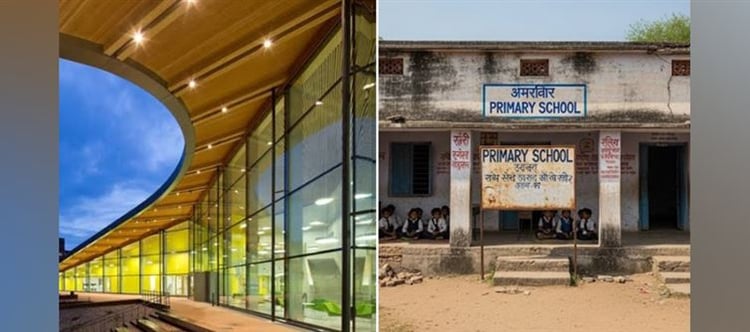

The stark contrast between the educational infrastructure of finland and india has once again sparked a global conversation, as highlighted by a recent post from @IndianGems_ on X. The images juxtapose a modern, government-funded school in finland with its sleek glass architecture, vibrant interiors, and advanced facilities against a dilapidated primary school in india, characterized by weathered walls, minimal amenities, and a rudimentary setup.
This visual comparison underscores a perplexing question: despite India’s GDP being 15 times larger than Finland’s, why has the nation struggled to provide similar quality education infrastructure to its vast student population? The Finnish school, with its contemporary design and well-maintained environment, reflects a system where education is a priority, supported by a small population of approximately 5.5 million and a decentralized, municipally-driven funding model.
The disparity raises critical points about resource allocation and population challenges. Finland’s education system benefits from a low student-to-teacher ratio and a focus on equitable access, enabled by its modest population size and robust public funding. In contrast, india, with a population exceeding 1.4 billion, faces immense pressure to cater to a diverse and expansive student base, where over 10.17 lakh of its 14.71 lakh schools are government-run.
The indian school depicted in the images, likely from a rural area, exemplifies the infrastructural gaps—lack of functional electricity in 1.52 lakh schools and inadequate drinking water facilities in thousands more—as reported in recent government data. This highlights a systemic issue where economic growth has not yet translated into proportional investment in education, compounded by socio-economic factors and uneven regional development.
Responses on X range from attributing the gap to historical mismanagement and population pressures to calls for population control and better resource distribution. While some defend India’s progress by showcasing improved schools in urban areas, the reality for many rural students remains grim.
Finland’s success, driven by a culture of education, minimal private school presence, and significant public investment, offers a model worth studying. For india, the challenge lies in scaling such quality education across its vast landscape, necessitating innovative solutions, increased funding, and a unified national effort to ensure that every child, regardless of location, has access to a conducive learning environment.
This visual comparison underscores a perplexing question: despite India’s GDP being 15 times larger than Finland’s, why has the nation struggled to provide similar quality education infrastructure to its vast student population? The Finnish school, with its contemporary design and well-maintained environment, reflects a system where education is a priority, supported by a small population of approximately 5.5 million and a decentralized, municipally-driven funding model.
The disparity raises critical points about resource allocation and population challenges. Finland’s education system benefits from a low student-to-teacher ratio and a focus on equitable access, enabled by its modest population size and robust public funding. In contrast, india, with a population exceeding 1.4 billion, faces immense pressure to cater to a diverse and expansive student base, where over 10.17 lakh of its 14.71 lakh schools are government-run.
The indian school depicted in the images, likely from a rural area, exemplifies the infrastructural gaps—lack of functional electricity in 1.52 lakh schools and inadequate drinking water facilities in thousands more—as reported in recent government data. This highlights a systemic issue where economic growth has not yet translated into proportional investment in education, compounded by socio-economic factors and uneven regional development.
Responses on X range from attributing the gap to historical mismanagement and population pressures to calls for population control and better resource distribution. While some defend India’s progress by showcasing improved schools in urban areas, the reality for many rural students remains grim.
Finland’s success, driven by a culture of education, minimal private school presence, and significant public investment, offers a model worth studying. For india, the challenge lies in scaling such quality education across its vast landscape, necessitating innovative solutions, increased funding, and a unified national effort to ensure that every child, regardless of location, has access to a conducive learning environment.
 click and follow Indiaherald WhatsApp channel