



⚡THE ELEPHANT IN THE ROOM NOBODY WANTS TO TALK ABOUT
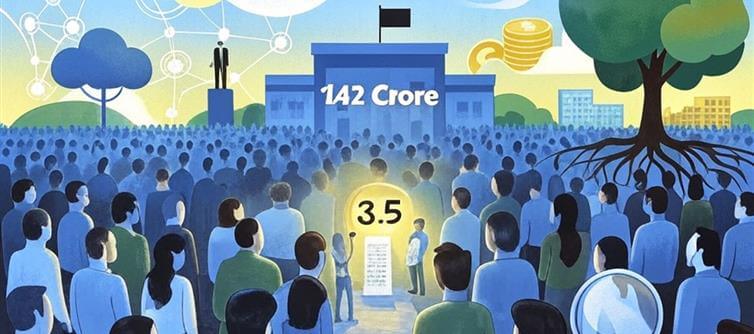
india has 142 crore people.
And guess how many actually pay income tax?
3.50 crore.
Barely 3% of the country.
This isn’t just a statistic.
This is the single most important, most ignored, most explosive truth about India’s economy, governance, and middle-class frustration.
Every time the government raises taxes, the middle class asks:
“Why us? Why always us?”
This—right here—is the answer.
Because India’s tax system stands on the back of a microscopic minority, while the remaining population either earns below the taxable limit, stays outside the net, or operates entirely in cash.
And the people who do pay tax?
They carry the weight of an entire nation.
💥 1. THE BRUTAL NUMBERS — INDIA’S TAX ECOSYSTEM IS A PYRAMID STANDING ON A PIN
| Category | Number |
|---|---|
| Total Population | 142.21 crore |
| PAN–Aadhaar Linked | 52.69 crore |
| PANs Registered in E-Filing | 11.93 crore |
| ITRs Filed | 7.30 crore |
| Actual Taxpayers (those who owe tax) | 3.50 crore |
Now the gut-punch:
➡️ Only 3.5 crore people actually pay income tax
➡️ That’s 2.46% of the population
➡️ Meaning 97.5% of india does NOT pay income tax
Let that sink in.
The world’s most populated country is run by the tax contributions of a population smaller than many indian states.
This is not sustainable.
This is not fair.
This is not normal.
💣 2. INDIA’S MIDDLE CLASS: THE MOST OVER-TAXED, UNDER-REWARDED GROUP IN THE COUNTRY
Despite being the backbone of the tax system, the middle class gets:
No major tax relief
No significant subsidies
No welfare schemes
No government cushioning
No political sympathy
No targeted benefits
They get one thing consistently:
More taxes.
Every budget feels like a punishment.
Every rise in GST feels like daylight robbery.
Every compliance rule feels like a trap.
And yet… this tiny 3% continues to keep the country afloat.
🧨 3. THE REALITY CHECK — IT’S NOT JUST EVASION, IT’S A STRUCTURAL PROBLEM
Many assume “97% don’t pay tax = 97% are evading tax.”
Reality is more complex:
✔ Large rural population
Low incomes = No taxable income.
✔ Massive informal sector
Crores of people earn in cash, outside formal payrolls.
✔ Agricultural income
Fully exempt from income tax, even for large landowners.
✔ Under-reporting
A consistent issue across sectors.
✔ Multiple loopholes
Allow high earners in specific occupations to stay under the radar.
But the end result doesn’t change:
The tax burden falls on the same 3%. Every. Single. Year.
⚠️ 4. THE GOVERNMENT’S DILEMMA — CAN’T TAX THE POOR, CAN’T ANGER THE RICH, SO THEY SQUEEZE THE MIDDLE
The government cannot raise direct taxes on the poor.
The wealthy have mechanisms to optimise or shield income.
The corporate sector negotiates incentives and exemptions.
Who’s left?
Salaried employees.
The easiest, most compliant, most traceable taxpayers.
Your tax is deducted before your salary reaches your account.
No escape.
No negotiation.
No refund unless the system feels generous.
And because this group cannot dodge tax, it becomes the government’s favourite target.
🔥 5. THE HARD TRUTH — india DOES NOT HAVE A TAX COMPLIANCE PROBLEM. india HAS A TAX BASE PROBLEM.
The real crisis is not that people evade.
It’s that too few people earn enough to be taxed, and too many who should pay… don’t.
india needs:
More formal jobs
Higher incomes
Wider tax net
Less cash economy
Better enforcement
Fairer policies
But instead, the middle class bears the brunt while the system pretends everything is fine.
🔥 CONCLUSION — india CAN’T BE A DEVELOPED ECONOMY ON THE SHOULDERS OF JUST 3%
A nation of 142 crore people cannot keep surviving on the tax money of 3.5 crore citizens.
This isn’t economics.
This is exploitation disguised as fiscal policy.
Until india expands its tax base, reforms exemptions, and formalises employment, the middle class will continue to feel:
Squeezed
Ignored
Burdened
Unrewarded
And completely taken for granted
Because right now, India’s tax system has one silent message for its honest taxpayers:
“Thank you for paying.
And sorry — but you’re on your own.”
 click and follow Indiaherald WhatsApp channel