



When Accountability Meets a Wall of Noise
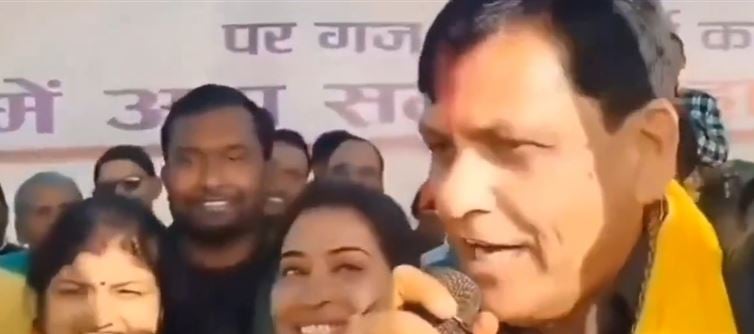
A Union minister is asked a direct question on public anger over UGC rules.
The cameras are rolling. The question is clear.
There is no answer.
Instead, the minister raises his voice—“Har Har Mahadev”—and walks away.
The minister is Nityanand Rai. And the moment is now doing the rounds for what it represents—not faith, but flight.
1️⃣ The Question That Didn’t Get an Answer
Policy questions are not ambushes. They are the price of power.
When concerns around education reforms trigger unrest, citizens expect explanations—data, reasoning, timelines. What they got instead was a slogan and an exit.
That substitution matters. Because governance doesn’t run on chants; it runs on answers.
2️⃣ Not an Isolated Moment—A Pattern
This wasn’t new. It echoed an earlier episode in Uttar Pradesh, where a power minister—questioned about frequent power cuts—responded by shouting “Bajrang Bali ki jai” and leaving.
Different states.
Different portfolios.
Same response.
When repetition appears, it stops being a coincidence and starts looking like a strategy.
3️⃣ Faith as Faith vs Faith as Firewall
Faith belongs in private belief and public culture—not as a smoke screen.
Invoking deities to avoid scrutiny does two harmful things at once:
It dilutes accountability, and
It instrumentalizes religion for political escape.
Neither serves democracy. And neither serves faith.
4️⃣ The politics of Noise Over Answers
Shouting a slogan accomplishes one thing efficiently: it kills the follow-up.
No rebuttal is possible.
No clarification is allowed.
No accountability survives the volume.
This is not a debate.
This is disruption disguised as devotion.
5️⃣ What This Signals to Citizens
When elected representatives refuse to answer policy questions:
frustration grows,
institutions weaken,
Cynicism hardens.
If those in power can walk away from questions, why should citizens believe promises?
A democracy that replaces explanations with exclamations is not confident—it’s defensive.
6️⃣ Why This Keeps Working
Because it shifts the conversation.
Anyone who insists on answers can be painted as:
anti-faith
disrespectful
hostile
The issue quietly moves from policy failure to cultural confrontation. And that’s the trick.
It’s easier to polarize than to explain.
7️⃣ The Cost to Governance—and to Religion
Governance demands clarity.
Religion demands sincerity.
Blurring the two cheapens both.
When gods are summoned to dodge responsibility, faith becomes a prop—and public trust takes the hit.
🔚 Final Word: Democracy Runs on Answers, Not Chants
Citizens don’t elect priests.
They elect representatives.
Invoking divinity to avoid accountability may win a moment—but it loses something far more important: credibility.
If the ruling establishment—especially Bharatiya Janata Party—wants to lead a confident democracy, it must prove one simple thing:
That it can face hard questions without hiding behind holy slogans.
Because gods don’t govern.
People do.
 click and follow Indiaherald WhatsApp channel