



THE METAL EVERYONE WANTS — AND NO ONE WANTS TO PAY FOR
silver is on fire.
Solar panels.
EVs.
Electronics.
Data centers.
Defense tech.
Demand is skyrocketing. Headlines scream multi-year supply deficits. Prices surge. Bulls declare a supercycle.
But here’s the uncomfortable truth most silver evangelists won’t say out loud:
👉 Silver is not a profit center. It’s a cost problem.
And markets don’t reward cost problems for long.
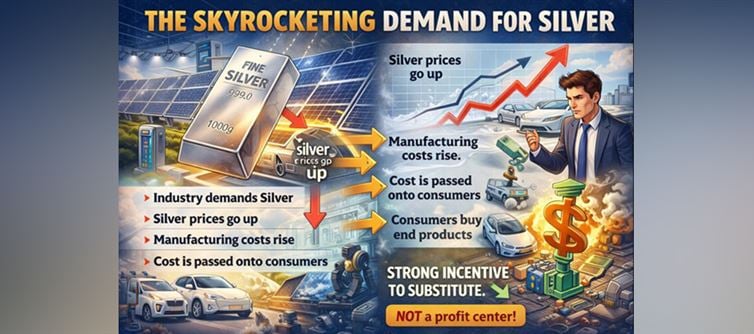
THE silver CHAIN REACTION
1. industry Needs Silver
Silver is a critical input in solar cells, EVs, electronics, and advanced manufacturing. Demand rises structurally.
2. silver Prices Go Up
Supply struggles to keep up. Mining is slow. Deficits emerge. Prices spike.
3. Manufacturing Costs Rise
For companies, silver isn’t revenue — it’s an expense. Every price increase hits margins directly.
4. Costs Are Passed to Consumers
EVs, electronics, and energy systems get more expensive. Inflation sneaks in through the supply chain.
5. Consumers Push Back
Demand elasticity kicks in. Sales slow. Pressure builds — not on miners, but on manufacturers.
This is where the story changes.
WHY HIGH silver PRICES PLANT THE SEEDS OF THEIR OWN DESTRUCTION
1. Substitution Becomes Inevitable
When silver gets expensive, engineers don’t panic — they innovate.
Copper blends
silver “thrifting” (using less per unit)
Alternative conductive materials
New manufacturing processes
Every price spike accelerates silver’s replacement.
2. No Pricing Power = No Moat
Silver isn’t a brand.
It isn’t patented.
It isn’t irreplaceable.
It has zero control over how much customers want to pay.
3. Industrial Demand Is Ruthless
Industries don’t fall in love with metals.
They use what’s cheapest and good enough.
The moment silver becomes “too expensive,” it stops being essential.
4. Compare This to True Profit Centers
Software raises prices → margins expand
Luxury brands raise prices → demand survives
Cost inputs raise prices → customers revolt
silver sits firmly in category three.
THE BULL CASE — AND WHY IT’S INCOMPLETE
Yes:
Solar capacity is exploding
EV adoption is accelerating
Electronics demand is relentless
Supply deficits are real
But here’s what bulls ignore:
📌 High prices do not strengthen silver’s position — they weaken it.
They push:
Substitution
Efficiency
Technological leapfrogging
All enemies of long-term price dominance.
THE CORE PROBLEM: NO DURABLE MOAT
Silver’s demand is:
Derived, not discretionary
Industrial, not emotional
Price-sensitive, not loyal
That means:
Booms are violent
Busts are faster
Long-term dominance is fragile
Great for traders.
Dangerous for long-term conviction investors.
THE BIGGER PICTURE
silver shines brightest in shortages and hype cycles — not in sustained pricing power.
When the world needs more silver, prices rise.
When prices rise, the world works overtime to need less silver.
That feedback loop never disappears.
THE BOTTOM LINE
Silver’s industrial boom is real.
So is the demand.
So are the deficits.
But silver is still just a cost center wearing a bull market mask.
And cost centers don’t own the future — they get engineered around.
High reward? Possibly.
High risk right now? Absolutely.
 click and follow Indiaherald WhatsApp channel