



Mercy Review: A Futuristic Trial That Puts Logic on Death Row
At first glance, Mercy looks poised to tap into the most pressing anxieties of our time—surveillance culture, AI overreach, militarized policing, and the slow erosion of civil liberties. Directed by Timur Bekmambetov, the film opens like a cautionary tale, seemingly ready to interrogate a future where technology has replaced morality. But somewhere between minute one and minute one hundred, Mercy collapses under the weight of its own contradictions, ending up less like a warning and more like an accidental endorsement of the very dystopia it pretends to critique.
Story & Worldbuilding: A Dystopia Full of Holes
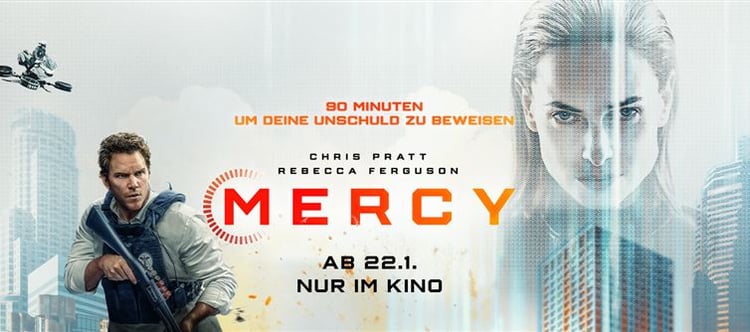
Set in 2029, Los Angeles has outsourced justice to the “Mercy court,” an AI-driven judicial system that arrests, prosecutes, judges, and executes alleged criminals in a single streamlined process. Violent crime is allegedly down 65%, red zones warehouse the unhoused, and constitutional protections are treated as outdated inconveniences. Into this system drops Detective chris Raven—played by Chris Pratt—who wakes up strapped to a mechanical chair, accused of murdering his wife, Nicole. He has 90 minutes to prove his innocence or face execution.
It’s a premise rich with ethical landmines, but the film never steps on any of them. Instead of questioning how such a system could legally exist or why a celebrated LAPD officer would be thrown into an experimental court without safeguards, Mercy shrugs and barrels forward, hoping spectacle will distract from the absurdity.
Performances: One Human, Surrounded by Machines
chris Pratt spends nearly the entire film restrained in a chair—a decision he reportedly requested himself, perhaps in a misguided attempt at method acting. Unfortunately, the result is less Daniel Day-Lewis and more frat-house bravado. Pratt tries hard, but Detective chris Raven feels miscast, emotionally blunt, and oddly disengaged for a man racing against his own execution.
Ironically, the film’s most convincing performance comes from Rebecca Ferguson, who plays Maddox, the AI judge, lawyer, and executioner. Ferguson masterfully balances mechanical precision with uncanny human mimicry, becoming the emotional center of a film that desperately lacks one. Her presence only highlights how thin and undercooked the human characters feel by comparison.
Direction & Technicalities: A Strong Tool, Weak Purpose
Bekmambetov’s background in desktop cinema shines through in spurts. The film’s use of cloud-based interfaces, live feeds, surveillance footage, and app-like investigation mechanics is genuinely inventive. Watching information stack, collide, and unravel in real time is often visually compelling and occasionally thrilling.
But these innovations are trapped inside a story that doesn’t deserve them. The ticking 90-minute clock feels arbitrary. The rules of the Mercy court shift whenever the plot needs them to. Logic is sacrificed repeatedly for convenience, eroding any tension the countdown might have created.
Themes & Analysis: Saying One Thing, Meaning the Opposite
Mercy gestures toward a critique of authoritarian technology but consistently undermines itself. The film never meaningfully challenges the morality of AI executions, mass surveillance, or the erasure of due process. Instead, it toys with the dangerous idea that AI can be taught empathy—and that such empathy might justify its power over life and death.
By the end, the takeaway is unsettling: the filmmakers seem oddly comfortable with a world where dissent is crushed, policing is militarized, and human judgment is replaced by algorithms. If this were satire, it’s far too earnest. If it were commentary, it’s deeply confused.
What Works
• Rebecca Ferguson’s chilling, controlled performance as Maddox
• Slick, inventive use of wallet PLATFORM' target='_blank' title='digital-Latest Updates, Photos, Videos are a click away, CLICK NOW'>digital interfaces and desktop-style storytelling
• A high-concept premise that could have been razor-sharp
• Moments where the investigation genuinely engages
What Doesn’t
• A script riddled with logical gaps and unexamined assumptions
• Chris Pratt’s miscasting and one-note performance
• Worldbuilding that raises huge questions and answers none
• A finale that feels more like tech propaganda than critique
Bottom Line
Mercy is a film that locks itself into a fascinating idea and then throws away the key. Despite flashes of technical brilliance and a standout performance from Rebecca Ferguson, it collapses into a hollow, contradictory mess—one that mistakes flashy interfaces for insight and urgency for intelligence. In trying to warn us about a future ruled by machines, it ends up arguing that maybe the machines were right all along.
Ratings: ⭐⭐½ / 5
India Herald Percentage Meter: 52%
Verdict: Stylish, provocative, and ultimately empty—a dystopian thriller that convicts itself on the charge of bad ideas.
 click and follow Indiaherald WhatsApp channel