


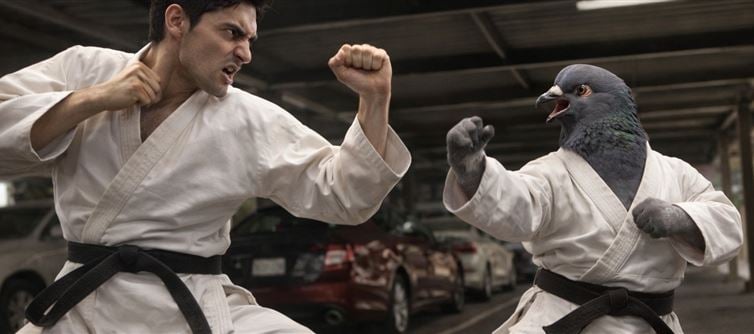

Come morning, noon, or evening — they’re still there. Same ledge. Same faces. Same apathy. You scare them, they don’t move. You scare them properly, they fly two meters and return to the exact same spot like nothing happened. While other birds migrate across continents, hunt, get hunted, build intricate nests, and play their part in evolution, these just sit and drop. And somehow, we’ve convinced ourselves that keeping them alive by force-feeding grains is compassion.
🧠 This Isn’t Nature. This Is Stagnation.
Wildlife survives because it adapts. Pigeons in cities don’t adapt — they depend. Human feeding has replaced instinct. Overcrowding has replaced natural selection. The result is a bloated, sedentary population with zero ecological contribution beyond fouling buildings and lungs.
This isn’t coexistence. It’s coddling.
🧬 The Quiet health Risk Nobody Wants to Talk About
Bird droppings aren’t harmless dirt. Dried pigeon feces can carry fungal spores that, when disturbed and inhaled, cause serious lung infections — one of them already well documented: histoplasmosis. It doesn’t need a dramatic outbreak to be dangerous. It thrives quietly, spreads through the air, and hits hardest where hygiene and awareness are lowest.
All it takes is one mutation. One wrong turn. And the “harmless feeding ritual” becomes a public health headline.
🧪 “Don’t Feed Them.” ≠ “You’re Killing Them”
Here’s where logic collapses into emotion. Not feeding pigeons does not mean you’re killing them. If that were true, then anyone who takes antibiotics, antivirals, or antifungals would be committing genocide against microorganisms every day.
Nature regulates populations. Humans distort them.
🌍 Earth Doesn’t Need Us to Scatter Grains
This planet is home to millions of species that survived for millennia without human handouts. Each species evolved instincts, behaviors, and a place in the food chain. mass feeding breaks that chain. It encourages overbreeding, spreads disease, and concentrates animals unnaturally in dense urban pockets.
Feeding should be reserved for pets — and for species genuinely at risk of extinction, especially when we are the reason their habitats were destroyed. Pigeons do not qualify.
⚖️ Why the Backlash Says More About Us Than the Birds
When the Maharashtra Government moved to ban public pigeon feeding, the outrage was immediate. As if pigeons would collapse without human charity. As if nature itself would fail without our daily grain offerings.
India is vast and diverse, which also means someone will always be offended, no matter how sensible the decision. But offense is not an argument. Science is.
🧩 Human Intervention Is the Actual Disruption
mass feeding of pigeons (and street animals) doesn’t help ecosystems — it warps them. It turns cities into disease incubators and animals into dependent populations. Compassion without understanding becomes cruelty in slow motion.
We keep thinking we’re saving them.
In reality, we’re trapping them — and risking ourselves.
🩸 Final Word
The end of humanity won’t necessarily come with explosions or rising seas. It might arrive quietly — inhaled from dust, transmitted through air, or ignored because it offended someone’s sentiment.
The pigeons will still be there.
Same spot. Same faces. Same life.
The question is whether we’ll still be here with them — or whether we finally choose science over symbolism before it’s too late.
 click and follow Indiaherald WhatsApp channel