


 Did CM Stalin Finish What Karunanidhi Left Unsaid? How Stalin Rewrote Women’s Politics in Tamil Nadu
⚡POWER IS NOT JUST ABOUT DOING—IT’S ABOUT BEING SEEN DOING IT
history is not written only by those who act.
It is written by those who make action visible.
tamil Nadu’s political journey on women’s empowerment proves this brutally.
M. Karunanidhi laid the foundations that were revolutionary for their time.
But foundations alone don’t win mass faith.
That gap—between governance and perception—is where politics either survives or dies.
And it is exactly the gap M. K. Stalin has ruthlessly closed.
🧱 KARUNANIDHI: THE ARCHITECT WHO NEVER MARKETED HIS LEGACY
karunanidhi was decades ahead of his time in policy.
women were inducted into the police force for the first time in India
Free bus passes for girls
Support for self-help groups and women’s collectives
These were not symbolic gestures. They were structural reforms.
Yet, karunanidhi failed at one crucial political skill: selling his achievements.
There was no aggressive narrative.
No emotional framing.
No mass-level communication that converted policy into pride.
Governance happened.
Perception didn’t.
That failure mattered.
📣 THE COST OF SILENCE: WHEN ACHIEVEMENT DOESN’T TRANSLATE INTO VOTES
politics is unforgiving.
Karunanidhi’s work for women remained largely confined to files, laws, and administrative circles. It never became a popular movement.
As a result, an uncomfortable truth emerged:
Doing the right thing is not enough if people don’t feel it.
That vacuum was quickly filled by someone who understood optics far better.
🐯 JAYALALITHAA: THE POWER OF MYTH OVER MEASURES
J. Jayalalithaa didn’t build her image through policy depth.
She built it through fear, symbolism, and narrative control.
“She will cut off the hand that touches a woman” became a political slogan—repeated, amplified, weaponised.
But reality told a different story:
Acid attacks on women occurred during her tenure
Women’s issues were selectively ignored in mainstream discourse
Structural empowerment initiatives were minimal
Yet women voters rallied behind her.
Why?
Because perception beats performance.
Because image-crushed evidence.
That’s politics.
🔄 STALIN’S TURN: FIXING THE GAP FIRST, NOT LAST
stalin learned from both his predecessors.
His first move as chief minister was not symbolic—it was strategic:
Free bus travel for women
Monthly financial assistance (urimai thogai)
Working women's hostels
“Thozhi” schemes
Recognition and celebration of women achievers
But the real shift wasn’t just in policy.
It was in communication.
📱 THE REAL GAME-CHANGER: VISIBILITY, NARRATIVE, REACH
Under stalin, women-centric governance didn’t remain buried in government orders.
It became:
This time, governance spoke loudly.
Social media did what karunanidhi never fully used—it turned policy into public emotion.
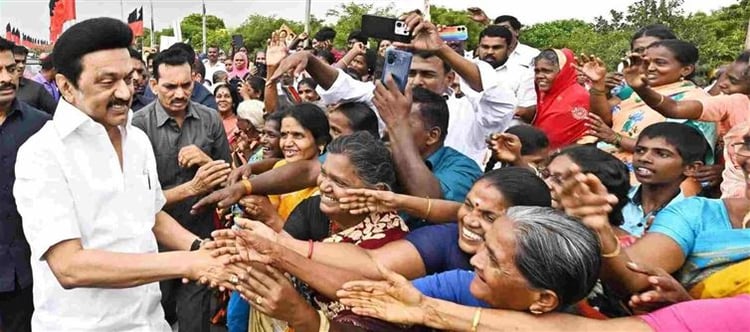
👥 A VISIBLE SHIFT ON THE GROUND
The change is no longer theoretical.
Earlier:
DMK rallies were overwhelmingly male
women appeared symbolically, not numerically
Now:
women dominate crowds
Grassroots participation has flipped
Once upon a time, women gathered when jayalalithaa arrived.
Today, that equation has visibly shifted.
This is not an accident.
This is design.
🎯 FINAL VERDICT: stalin DID WHAT history DEMANDED
karunanidhi built the framework.
Jayalalithaa mastered myth.
Stalin combined delivery + display.
He did not just talk about women’s empowerment.
He institutionalised it and made it impossible to ignore.
That is the difference between intention and impact.
And that is why, yes—Stalin completed what karunanidhi left unfinished—not in policy, but in perception.
 click and follow Indiaherald WhatsApp channel