


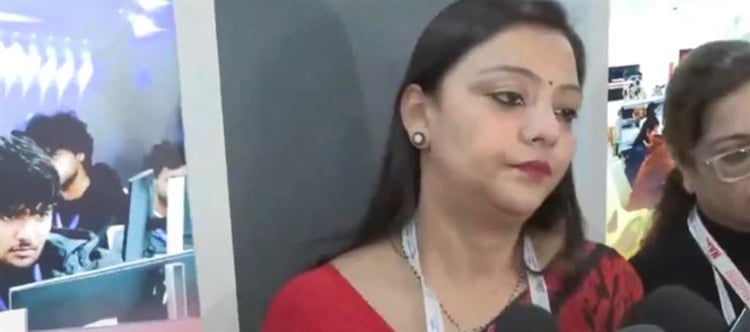

💔 From Prime Time Pride to “Open to Work”: The Neha Singh Story That’s Breaking the Internet
There are controversies.
And then some controversies quietly crush someone who was never meant to be the villain.
This is one of those stories.
It begins not with scandal—but with excitement.
🎤 1. The Big Moment She Earned
Neha Singh had been working for years in the communications department at Galgotia University. Not a headline-maker. Not a political face. Just a professional doing her job.
When she was told she would represent the university’s robotic dog at a major AI Summit, it was a career milestone. She was informed that the machine was developed by the robotics department. She trusted the briefing she was given—because that’s how institutional roles work.
You represent what your institution tells you to represent.
👗 2. The Human Side No One Talks About
She didn’t treat it like “just another assignment.”
She bought a new linen saree for the occasion.
She straightened her hair at a local salon.
She messaged her parents and asked them to switch on DD news so they could watch her interview.
That detail matters.
Because this wasn’t politics to her. It was pride.
It was validation.
It was a daughter telling her family, “Look, I made it.”
🤖 3. Then Came the Twist
Soon after the summit appearance, reports began circulating that the robotic dog showcased at the event was allegedly of Chinese origin.
What followed wasn’t an internal clarification.
It was a media frenzy.
The outrage machine needed a face. And unfortunately, the most visible face was the woman who had been sent to speak.
Not the procurement process.
Not the technical team.
Not the oversight mechanisms.
Just her.
🧨 4. The Blame Game Escalates
As the controversy snowballed, fingers were pointed toward the institution, its robotics department, and even questions were raised about oversight at higher levels, including Union minister Ashwini Vaishnaw.
But in the public glare, nuance rarely survives.
Instead of institutional accountability, the spotlight narrowed.
And it narrowed down to one individual.
💼 5. “Open to Work”
Amid mounting pressure and speculation, reports emerged that she was being removed from her position.
Shortly after, her LinkedIn bio reportedly changed to a quiet, devastating phrase:
“Open to work.”
Two words.
Years of work reduced to two words.
⚖️ 6. The Question We’re All Thinking
Was she responsible for procurement decisions?
Was she in charge of background verification?
Did she design, import, or audit the technology?
Or was she simply the communications professional assigned to present what her institution endorsed?
In high-visibility controversies, the loudest punishment often lands on the most accessible person—not necessarily the most accountable one.
💔 7. The Larger Conversation
This incident has triggered a broader debate online—about institutional responsibility, scapegoating, and whether women in visible roles often bear disproportionate scrutiny when systems fail.
It’s not about defending mistakes.
It’s about asking:
When something goes wrong, who actually made the decision?
And why does the fallout sometimes bypass power and land on proximity?
🌧️ The Real Story Behind the Noise
Strip away the politics. Remove the hashtags.
What remains is a professional who prepared for her big day, trusted her briefing, and stood before cameras believing she was representing her university with pride.
Within days, she was defending her credibility.
In public controversies, narratives move fast. Careers break faster.
And sometimes, the person who paid the price wasn’t the one who made the call.
That’s the part that hurts.
 click and follow Indiaherald WhatsApp channel