


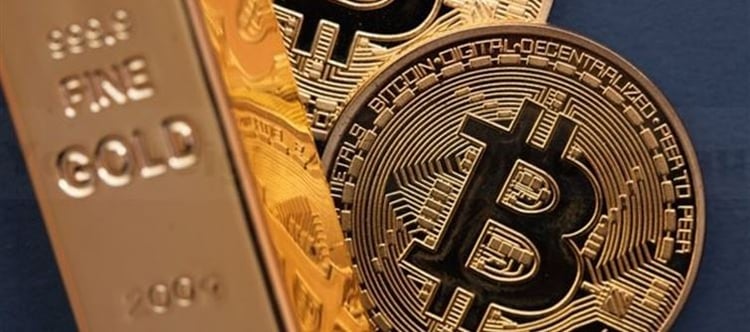

Something strange just played out in global markets—and most people are reading it completely wrong. In the middle of a geopolitical crisis, gold—traditionally the ultimate haven—dropped hard, while Bitcoin quietly climbed. At first glance, it looks like a changing of the guard. It’s not. The real story runs deeper, and it’s far more unsettling.
Start with the shockwave. oil surged, inflation expectations spiked, and bond yields followed. The 10-year yield pushing past 4.4% changed everything. Suddenly, holding gold—an asset that yields nothing—became expensive. Not because investors stopped believing in it, but because they needed liquidity fast. So they sold. Simple as that.
Now look at Bitcoin. It didn’t “win” because it replaced gold. It absorbed flows because it was available. Always on, 24/7, no closing bell, no friction. When institutions needed to move capital instantly—even at odd hours—Bitcoin’s infrastructure was ready. Gold’s wasn’t.
But here’s where it gets serious. The same conflict driving this market behavior is quietly hitting something far more critical: helium. A niche resource that most people ignore but underpins semiconductor manufacturing. With Qatar’s production disrupted, supply is tightening fast. And without helium, chip production slows. No chips, no AI scaling. No AI scaling, rising costs everywhere.
That’s the chain reaction markets haven’t fully priced in yet.
This isn’t a clean narrative of Bitcoin overtaking gold. It’s a messy, evolving system where physical supply chains are cracking while financial systems adapt in real time. gold moves with yields. Bitcoin moves with liquidity: two assets, two entirely different forces.
And the divergence? It won’t last forever. If yields ease, gold snaps back. If Bitcoin flows reverse, momentum fades.
So don’t watch the headlines. watch the flows. watch the yields. And more importantly—watch the invisible pieces, like helium, quietly shaping the next global shift.
 click and follow Indiaherald WhatsApp channel