


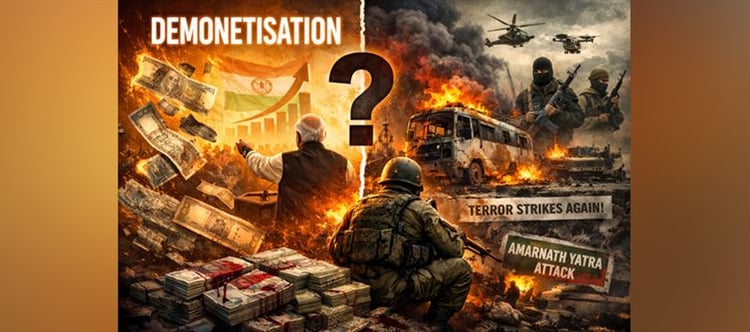

There’s a certain comfort in believing that one bold policy move can cripple something as complex as terrorism. It’s clean, cinematic, and easy to sell. But reality? It rarely plays along. While the narrative that demonetisation “broke the backbone of terror funding” gained traction, the years that followed told a far messier, more unsettling story—one that doesn’t quite fit the script.
THE TIMELINE THAT WON’T STAY QUIET:
Barely had the ink dried on demonetisation when violence resurfaced. november 2016 alone saw multiple attacks—on the 19th, 27th, and 29th—raising early doubts about the sweeping claim. Then came 2017, when the amarnath yatra attack shook the nation, a grim reminder that the threat was far from dismantled.
In 2018, the Sunjuwan military station attack reinforced that organized strikes were still very much operational. A year later, Pulwama delivered one of the deadliest blows, exposing the scale and persistence of militant networks. If demonetisation had truly choked funding pipelines, the results weren’t showing where it mattered most—on the ground.
THE YEARS THAT FOLLOWED:
The pattern didn’t break. Bandipora and Sopore in 2020. The Jammu air Force station in 2021. Fast forward, and incidents like the Reasi and Kathua attacks in 2024, followed by pahalgam in 2025, continue to puncture the narrative.
THE BIG QUESTION:
So what exactly changed? If anything, these events suggest that terrorism adapted faster than policy could contain it. Funding routes evolve. Strategies shift. And the idea that a single economic move could dismantle an entire ecosystem now feels, at best, overly optimistic—and at worst, dangerously simplistic.
Because when the dust settles, one truth lingers: narratives may win headlines, but facts leave scars.
 click and follow Indiaherald WhatsApp channel