



Lee Cronin’s The Mummy Review: Resurrection Without Relief
A Bold Reimagining — Not That Mummy
Let’s get this absolutely clear upfront: this is not the Mummy you grew up with. There is no charismatic Imhotep, no swashbuckling desert adventure, no Indiana Jones-style treasure hunts, and definitely none of the charming romance or levity that Brendan Fraser and rachel Weisz brought to the franchise.
Instead, Lee Cronin delivers something far more unsettling—an intimate, psychologically corrosive horror film that weaponizes grief, absence, and the terror of something returning… fundamentally wrong.
Story: Grief Unearthed, Not Adventure Discovered
At its core, The Mummy is deceptively simple. charlie Cannon (Jack Reynor), a Cairo-based journalist, loses his young daughter Katie (Emily Mitchell) when she mysteriously vanishes into the desert. The emotional fallout fractures the family irreparably.
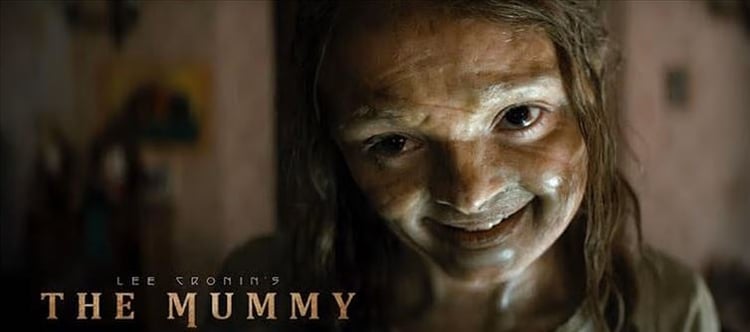
Eight years later, Katie returns.
But Cronin isn’t interested in relief or reunion. He leans into the dread of recognition—what happens when memory collides with something that only looks like what you lost. The narrative unfolds as an investigative slow-burn, peeling back layers of what truly happened in the desert while forcing the family—and the audience—to confront an unbearable possibility: some things should never come back.
Performances: Human Fragility Meets Unnatural Horror
The film thrives on its performances. Reynor and Laia Costa ground the story with raw, lived-in grief that never feels performative. Their dynamic captures the exhausting emotional tug-of-war between hope and denial.
May Calamawy, as investigator Dalia Zaki, brings a quiet, stabilizing presence—serving as both narrative anchor and audience surrogate amid escalating unease.
But the film belongs to Natalie Grace. Her portrayal of “returned” Katie is chilling in its restraint. Minimal dialogue, uncanny stillness, and sudden bursts of distorted physicality create a presence that is both tragic and deeply disturbing. She doesn’t just play a character—she embodies a question the film never fully answers.
Technical Craft: Controlled horror with Surgical Precision
Cronin, building on his work in Evil Dead Rise, trades relentless gore for sustained psychological tension—though when the violence hits, it lands hard.
A standout sequence involving the cutting of Katie’s overgrown nails is a masterclass in discomfort. It’s not about what’s shown, but how it’s framed—tight sound design, deliberate pacing, and an almost suffocating intimacy that makes the audience recoil.
The cinematography leans into muted palettes and claustrophobic framing, reinforcing the film’s emotional suffocation. Meanwhile, the score operates like a low, constant hum of dread, rarely exploding but never letting you breathe.
Analysis: A Deconstruction of Legacy Horror
Originally conceived as The Resurrected, this film’s transformation into The Mummy is deliberate—and subversive. Like The Invisible Man, it strips away iconic mythology to expose something more psychologically potent underneath.
Cronin essentially buries the old franchise, then resurrects it as something unrecognizable. This isn’t nostalgia—it’s a rejection of it.
The film operates as both horror and metaphor: resurrection here is not a miracle, but a violation. It interrogates grief, memory, and the human need to believe that what’s lost can return unchanged. Spoiler—it can’t.
What Works ✅
• Razor-sharp psychological horror that lingers long after viewing
• Natalie Grace’s haunting, breakout performance
• Strong emotional core anchored in grief and family trauma
• Precision use of gore—impactful, not excessive
• Oppressive atmosphere that never lets up
• Bold reinvention that dares to dismantle franchise expectations
What Doesn’t ❌
• Overlong runtime (~130+ minutes) stretches certain narrative beats
• Second half pacing drags slightly under its own weight
• Final act leans into more conventional horror spectacle
• Slight tonal disconnect between restrained buildup and explosive climax
Final Verdict
Lee Cronin’s The Mummy is a bold, unsettling reinvention that refuses to play by franchise rules. It abandons spectacle for psychological decay, delivering a film that is eerie, emotionally grounded, and at times deeply uncomfortable. While its pacing falters and its finale softens its uniqueness, the overall experience remains gripping and disturbingly effective.
This is not about ancient curses or cinematic escapism—it’s about the horror of getting back what you lost… and realizing it isn’t what you wanted.
 click and follow Indiaherald WhatsApp channel