



What started as a political disagreement has quickly spiraled into something far more personal—and far more telling about today’s political climate.
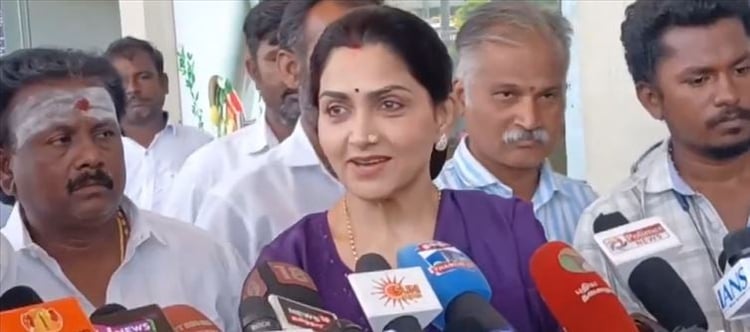
BJP leader Khushbu recently hit back at DMK’s Palanivel Thiaga Rajan (PTR), stating, “We are educated, dignified people,” in response to remarks she deemed derogatory toward her husband, actor and nda candidate Sundar C. On the surface, it sounds like a straightforward rebuttal. But the conversation didn’t stay there.
Because once the word “educated” entered the frame, the debate took a different turn altogether.
Supporters on either side began drawing comparisons—highlighting PTR’s academic credentials, including an engineering degree from NIT Trichy and advanced management education abroad, while questioning Khushbu’s own educational background. What could have remained a political disagreement quickly became a discussion about qualifications, merit, and who gets to claim intellectual authority in public life.
And that’s where things get tricky.
Because politics isn’t a classroom. Leadership isn’t measured solely by degrees, nor is it entirely detached from them. Public perception, experience, communication, and credibility all play a role. But when arguments shift from policy to personal credentials, the focus drifts away from issues that actually matter to voters.
At the same time, language matters.
Terms like “educated” and “dignified” carry weight, and when used in political exchanges, they can easily be interpreted as dismissive or provocative. That only deepens divides instead of fostering meaningful debate.
Ultimately, this episode reflects a broader pattern in modern politics—where discourse often slips from substance into symbolism, and from arguments into personal attacks.
The real question isn’t who is more qualified on paper.
It’s whether the conversation itself is moving the public forward—or simply generating more noise.
 click and follow Indiaherald WhatsApp channel