
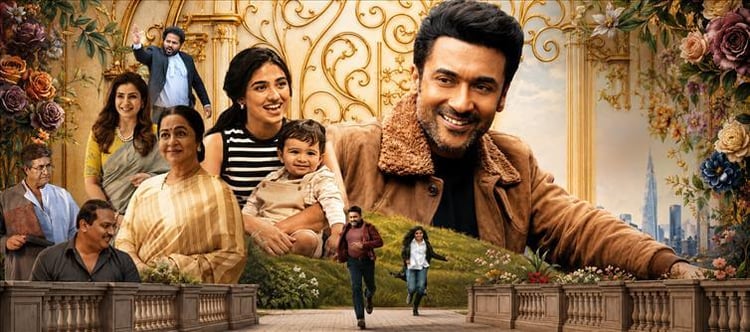


Vishwanath and Sons Review: Suriya and Mamitha Baiju Deliver a Warm New-Age Family Entertainer That Stumbles in the Second Half
Story
Venky Atluri’s Vishwanath and Sons follows Sanjay Vishwanath, an Olympic shooting gold medalist who eventually transforms himself into a billionaire businessman and crisis handler. Played by Suriya, Sanjay is over 40, successful, independent, and still unmarried, much to the constant concern of his mother, played by Radhika. Her repeated attempts to push him toward marriage become an important part of the family dynamic, giving the early portions a relaxed and humorous tone.
Sanjay eventually travels to the United States and returns to India a year later with a baby boy born through surrogacy. His carefully structured life takes an unexpected turn when the child requires a bone marrow transplant. With no other option available, Sanjay tracks down the surrogate mother, Maddy, in the US and brings her back to India, even if it means bending a few rules. Once Maddy enters the Vishwanath household, the film gradually shifts from a breezy family comedy into a story about motherhood, relationships, belonging, and emotional acceptance. What happens between Sanjay, Maddy, the child, and the rest of the family forms the heart of the narrative.
First Half: Fresh, Funny and Surprisingly Charming
The first half is easily the film’s biggest strength. Vishwanath and Sons begins in a familiar Telugu commercial-film template, introducing Sanjay as a skilled sharpshooter before explaining the incident that eventually changes the course of his life. While the opening portions feel somewhat conventional, the film becomes considerably more engaging once the family dynamics take center stage.
The comedy works best when it comes naturally from the characters rather than being forced into every scene. Mamitha Baiju’s Maddy is particularly well written. Her US upbringing, attitude, body language, dialogue delivery, and accent feel convincing without slipping into caricature. There is a natural energy to the character, and Mamitha plays her with enough restraint to avoid the overacting that often creeps into such roles.
The emotional relationship between Radhika and Suriya also works beautifully. Their mother-son chemistry gives the film much of its warmth, while the contemporary dialogue, Gen-Z references, and stylish presentation prevent the family drama from feeling old-fashioned. Venky Atluri deserves credit for attempting to make a traditional emotional story feel contemporary without completely abandoning its commercial roots.
The TV studio sequence is one of the film’s standout stretches. It gives Suriya a chance to deliver something beyond surface-level charm, and the writing manages to bring genuine emotion without resorting to excessive melodrama. The interval block also provides a neat payoff after the relatively slow build-up.
Second Half: Emotional Highs, Narrative Drift
The second half initially continues on a promising note. The central relationship develops further, and the film gets an emotional lift through Radhika’s character arc. Her emotional closure is one of the better-written portions of the latter half, and Suriya’s performance gives the sequence the weight it needs.
Unfortunately, the screenplay loses some of its focus after this point. Once the emotional thread involving Sanjay, Maddy, and the child begins to settle, the film struggles to identify a compelling new conflict. The backstory involving Sanjay’s second mother and the subplot surrounding her daughter’s attempt to marry to expand the family drama feel more like detours than organic extensions of the central narrative.
The wedding episode has moments of humour and emotion, but it is inconsistent. Nassar brings some much-needed comedy, yet the film increasingly relies on melodramatic beats instead of building stronger dramatic stakes. What could have been a tightly written family story starts feeling stretched.
This is where the contrast between the two halves becomes obvious. The first half feels fresh because it understands its characters and lets their personalities generate the entertainment. The second half occasionally seems to search for additional material after the primary emotional conflict has already been established.
Performances
Suriya is perfectly cast as Sanjay Vishwanath. He convincingly portrays a 40-year-old unmarried billionaire who is confident and successful but emotionally tied to his mother and deeply protective of his child. There is a maturity to his performance that suits the character, and he does particularly well in the emotional scenes. His performance becomes one of the major reasons the film remains watchable even when the screenplay starts losing momentum.
Mamitha Baiju is another major asset. Maddy could easily have become a stereotypical foreign-returned character, but the writing and Mamitha’s performance keep her grounded. Her accent, expressions, timing, and energetic screen presence work particularly well in the first half. She brings a youthful quality to the film without making the character feel artificial.
Radhika is excellent and arguably the emotional backbone of the movie. Even when the writing becomes ordinary, her screen presence elevates the material. Her chemistry with Suriya feels lived-in, and the emotional portions involving their relationship are among the film’s strongest moments.
The supporting cast is generally effective, with Nassar standing out whenever the film allows him to inject some humour. The ensemble contributes to the family atmosphere, although several supporting characters and subplots could have been trimmed without affecting the main narrative.
Direction and Writing
Venky Atluri’s direction shows its strongest qualities in the way it balances contemporary family dynamics with commercial entertainment. The film does not constantly shout its emotions at the audience, and several emotional scenes are allowed to breathe naturally. His handling of the mother-son relationship is particularly effective.
The writing, however, is uneven. There are genuinely sharp dialogues and well-conceived sequences, especially the TV interview scene and some of the emotional stretches. At the same time, the story occasionally falls back on familiar Telugu family-drama conventions. The second half would have benefited considerably from a tighter screenplay and a stronger central conflict.
The biggest writing issue is that the film does not fully exploit its most interesting premise. The surrogate mother entering a wealthy Indian family and developing an emotional relationship with the child provides enough material for a compelling family drama. Instead of consistently exploring that core, the screenplay moves into additional family subplots that dilute the emotional momentum.
Technicalities
The production values from Sithara Entertainments, Fortune Four Cinemas and Srikara Studios give the film a rich visual appearance. The Vishwanath household looks lavish, particularly in the exterior portions, and the overall presentation has the polished finish expected from a big-scale family entertainer.
Nimish Ravi’s cinematography is neat but somewhat repetitive. The lavish house provides an attractive setting, yet many indoor scenes repeatedly use similar compositions and backgrounds, making the film feel visually smaller than its production design suggests. A few early shots also appear slightly blurry, although this is not a major technical drawback.
Navin Nooli’s editing is adequate in the first half but could have been considerably sharper in the second. Several sequences feel longer than necessary, particularly once the film moves away from its primary emotional conflict. Better trimming could have significantly improved the pace and overall impact.
G.V. Prakash Kumar’s background score supports the emotional moments effectively. The film does not depend heavily on songs, which actually works in its favour. The already popular Mamitha Baiju track stands out, while the emotional song in the second half adds genuine warmth. However, a stronger album or another memorable musical number could have added more commercial value.
What Works
• Suriya’s casting: His mature, restrained performance fits Sanjay Vishwanath perfectly.
• Mamitha Baiju: Maddy is one of the film’s best-written characters, and Mamitha brings tremendous natural energy.
• Radhika-Suriya chemistry: Their mother-son relationship provides the film with its strongest emotional foundation.
• First-half comedy: The humour is largely character-driven rather than forced.
• TV studio sequence: Easily one of the film’s best-written and most emotionally effective scenes.
• Contemporary treatment: Gen-Z language, modern relationships, and polished visuals give the family drama a fresh identity.
• Emotional climax: The film eventually finds its heart again and gives the principal characters satisfying emotional closure.
• Limited dependence on songs: The narrative keeps moving without turning into a conventional song-heavy family entertainer.
What Doesn’t Work
• Second-half drift: The screenplay loses focus after the core emotional conflict begins to resolve.
• Unnecessary subplots: The second mother’s backstory and the wedding track feel more like extensions than essential parts of the story.
• Repetitive visuals: The lavish house looks impressive but is not explored creatively enough.
• Pacing: Several second-half portions could have been trimmed significantly.
• Uneven melodrama: Some emotional scenes work beautifully, while others feel overly stretched.
• Underused premise: The surrogate-mother/child/family dynamic had enough potential to sustain a much tighter and more emotionally powerful screenplay.
• Music: The score is effective, but the album lacks a strong chartbuster presence beyond the already popular track.
Analysis
Vishwanath and Sons works best when it stays close to its characters. Sanjay, his mother, Maddy, and the child form a naturally interesting emotional unit, and the film gets considerable mileage from watching these very different personalities gradually become a family. That is where Venky Atluri’s contemporary treatment pays off.
The problem is that the screenplay appears more confident in establishing the family than in sustaining the drama after the relationships have been established. The first half moves with a pleasant rhythm, combining comedy, emotion and character moments. The second half has several good scenes but lacks the same narrative discipline.
Still, the film deserves credit for avoiding the completely exhausting melodrama that often accompanies family dramas. Even when it becomes emotional, it generally tries to remain accessible and contemporary. The performances also compensate for several weaker stretches. Suriya, Mamitha Baiju and Radhika form a strong central trio, and their chemistry gives the film enough warmth to overcome its structural shortcomings.
The climax ultimately brings the film back to its emotional core. It may not completely erase the problems of the second half, but it leaves the audience with a reasonably satisfying feeling. That matters because Vishwanath and Sons is ultimately designed as a feel-good family experience rather than a high-concept dramatic thriller.
Verdict
Vishwanath and Sons is an engaging new-age family entertainer that gets many of its fundamentals right. The first half is fun, fresh and emotionally appealing, while the performances—particularly Suriya, Mamitha Baiju and Radhika—keep the film grounded. The second half, however, loses steam through unnecessary subplots, repetitive staging and an extended screenplay.
It is not a flawless family drama, but it is also far from a disappointing watch. There are enough well-written scenes, strong performances, emotional payoffs and entertaining stretches to make it a worthwhile one-time theatrical experience. The film ultimately leaves behind a warm aftertaste, even if the journey could have been considerably tighter.
Bottom Line
A warm-hearted family entertainer powered by Suriya, Mamitha Baiju and Radhika—brilliantly charming in the first half, noticeably stretched in the second, but ultimately saved by its emotions.
 click and follow Indiaherald WhatsApp channel