


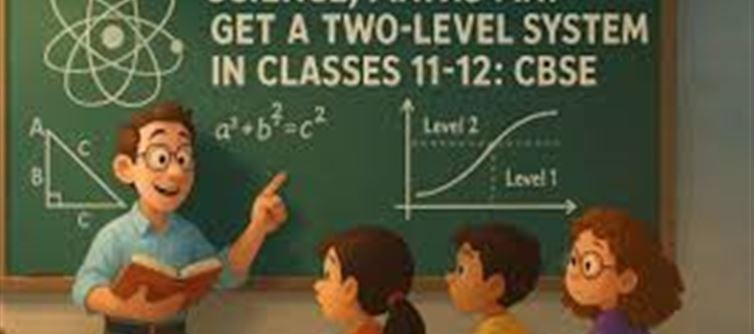

The Central Board of Secondary education (CBSE) is rolling out major curriculum changes aimed at making subjects like Mathematics and Science more accessible and flexible for students. These reforms are designed to ease academic pressure, offer more tailored learning paths, and help students focus on their strengths.
📍 New Two‑Level System in Mathematics and Science
One of the biggest reforms is the planned two‑tier (dual level) system for Mathematics and Science subjects:
🧠 What the Two Levels Mean:
CBSE will allow students to choose between:
· Standard Level: Designed for students who want a stronger foundation — suitable for future science, engineering, or competitive exam aspirations.
· Basic Level: Easier and less conceptually demanding — ideal for students who prefer general application without heavy theory.
Currently, this system already exists for Class 10 Mathematics with Basic and Standard papers, where the syllabus is the same but the question difficulty varies.
Now, CBSE is expanding this approach to Science and Social Science, starting from Class 9 in 2026 and planned for Class 10 board exams in 2028. students will be able to choose the level that best matches their learning pace and future plans.
🎯 Why This Makes Studying Easier
Here’s how students benefit from the new system:
🔹 Reduced Stress and Increased Choice
Not every student aims for science or math‑intensive careers. With Basic and Standard options, students can study at a level that fits their interests and abilities, reducing pressure and anxiety.
🔹 Aligned to National education Policy (NEP) 2020
These changes follow recommendations from the NEP 2020, which encourages offering subjects and exams at different difficulty levels so students aren’t forced into one size‑fits‑all assessment.
🔹 Gradual Transition in Curriculum
Science and Maths concepts are now structured so students can build understanding at their own pace — basic level reinforces fundamentals while the standard level goes deeper for those interested in advanced studies.
📘 Curriculum and Textbook Changes
To support these options:
· NCERT is working with CBSE to update textbooks for classes like 9 and 10, adding extra sections for advanced topics while keeping a common core curriculum.
· New books will be released ahead of academic sessions so teachers and students can prepare with the updated material in time.
This means curriculum restructuring, not just exam pattern tweaks — a fundamental step toward better teaching and learning alignment.
📊 How It Affects Board Exams
Under the new model:
· In Class 9 (from 2026), students will choose whether they study science and maths at Standard or Basic levels.
· For Class 10 board exams in 2028, boards will either offer:
o A single question paper with extra sections for advanced students, or
o Separate question papers for Basic and Standard levels.
This gives learners more control over the difficulty they face during high‑stakes board examinations.
🎓 What This Means for Students
📍 More Personalized Learning: students can focus on understanding concepts instead of memorizing hard content beyond their interest level.
📍 Reduced Coaching Burden: With appropriate difficulty levels built into the curriculum itself, students might rely less on external coaching to keep up — a major goal of NEP 2020.
📍 Better Preparation Choices: Those targeting competitive careers can pick the advanced level to boost readiness, while others can secure board exam success with the basic pathway.
📌 In Short
CBSE’s curriculum revisions — especially the introduction of two difficulty levels for Mathematics and Science subjects — are a big step toward making studying easier, more flexible, and better tailored to students’ needs. Already starting in Class 9 from 2026 and moving toward Class 10 board exams by 2028, this approach gives children choice, clarity, and confidence in their academic journey.
Disclaimer:
The views and opinions expressed in this article are those of the author and do not necessarily reflect the official policy or position of any agency, organization, employer, or company. All information provided is for general informational purposes only. While every effort has been made to ensure accuracy, we make no representations or warranties of any kind, express or implied, about the completeness, reliability, or suitability of the information contained herein. Readers are advised to verify facts and seek professional advice where necessary. Any reliance placed on such information is strictly at the reader’s own risk.
 click and follow Indiaherald WhatsApp channel