
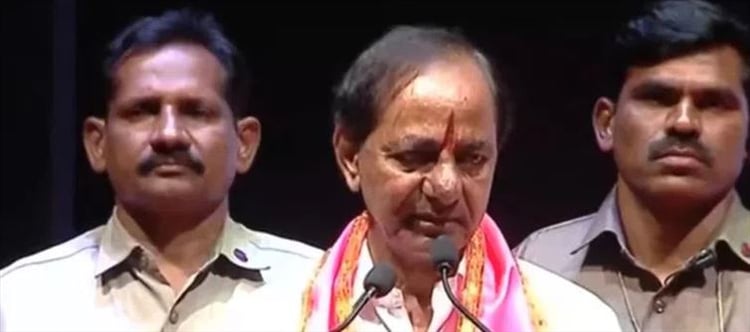


Chief minister K. Chandrashekhar Rao, the supremo of the Bharat Rashtra Samiti, declared that the nation was in desperate need of a radical transformation and that the BRS had been given the mandate to lead the "Bharat Parivarthan Mission" by the people. When he opened the BRS office in Nagpur, the second in Maharashtra, he said that a "Parivarthit Bharat"—a completely changed India—would be the solution to all of its problems. 

It is now necessary for Maharashtra, the home of mahatma Phule, baba Saheb Ambedkar, and Shivaji, to exercise much greater vigilance and serve as a catalyst for the much-needed transformation. He claimed that the BRS has taken on the responsibility to fight for transformation with a steely resolution and that the change was not beyond its scope.

He emphasized that the cruel game of winning being played by some political forces, who were determined to win at all costs even if it meant weakening the fundamental election standards, was the reason why the indian democratic system had gone wrong. However, the average person was a vast repository of common sense, and the desperately needed change for which he had fostered a mature desire was right on the verge of becoming a reality.

A democracy can only be successful if the people are the real victors. In the current system, one party's loss had been the other's gain. He continued, feeling that no real change could be achieved with only the transfer of power from one political order to another, an evident allusion to the karnataka elections where the outcome had seen the comeback of the congress at the expense of the BJP.


According to the chief minister, no one in the nation was requesting the moon. They had grown weary of protesting. They were all simply fighting for basic necessities like power, water to satiate their thirst, and a fair price for the agricultural products they produced. Consecutive governments had fallen short of meeting their need. Chief ministers from various political parties had long held office in Maharashtra. But he wondered why none of them was able to make a significant contribution to the state's development.

Devendra Fadnavis, a bjp leader in Maharashtra, was referred to as a "good friend of mine" by the speaker. He recalled that the current deputy chief minister had asked me what role I had to play in Maharashtra. I made it plain to him that, as in telangana, the state's citizens' basic needs must be provided. I would have no role in the state if Maharastra completely adopted the telangana model of growth, he joked.

No other state in the nation had as many enduring sources as Maharashtra, including the krishna and Godavari rivers that crossed it. However, many cities and villages continued to only receive water supplies every 10 days or every two weeks. Large cities, like Aurangabad, were not exempt from this embarrassing occurrence. Even worse days of scarcity were experienced in Delhi, the nation's capital. Despite being a part of the yamuna river delta, it rarely got enough water.


Find out more:
