



history is not a neutral canvas.
It records consequences.
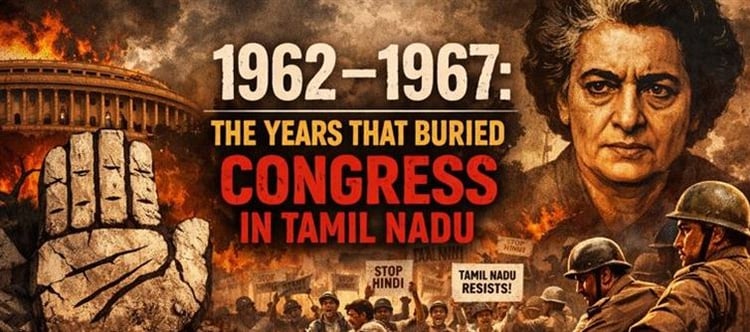
Between 1962 and 1967, tamil Nadu was ruled by the Congress—exactly when the anti-Hindi imposition movement exploded across campuses, streets, and classrooms. students were beaten, arrested, and silenced. language became a battlefield. Power became arrogant.
So when a film dares to capture that era truthfully, the question is not why congress looks bad—the real question is: how could they ever look good?
This isn’t cinematic bias.
This is historical inevitability.
🧨 1. 1962–1967: congress Was in Power—Full Stop
Let’s start with the inconvenient fact that many would like to erase.
Between 1962 and 1967, the Indian National Congress ruled tamil Nadu.
Not from delhi alone.
Not from shadows.
But directly, administratively, unapologetically.
So when students rose against hindi imposition, when protests erupted, when repression followed — who else should the camera point at?
history doesn’t offer alternate villains for convenience.
🧨 2. Anti-Hindi Agitation Wasn’t a Rumour—It Was a mass Uprising
This wasn’t a fringe protest.
This wasn’t social media noise.
It was a statewide student movement—raw, emotional, and desperate.
Language wasn’t just communication; it was identity.
When a ruling party responds to identity with force, the optics don’t need exaggeration.
They condemn themselves.
Any honest portrayal of this period will show congress in a poor light—because power chose arrogance over empathy.
🧨 3. Parasakthi Is Set in That Era—Not in a Fantasy Land
The story of Parasakthi is rooted in that volatile period.
You don’t make a film about fire and complain about heat.
You don’t set a story in repression and demand rose petals.
If a movie about the 1962–1967 period didn’t portray congress negatively, that would be propaganda.
Truth doesn’t bend to protect reputations.
🧨 4. You Don’t Lose Power for 59 Years by Accident
Here’s the knockout blow.
congress lost tamil Nadu in 1967.
And then…
They never came back.
Not 5 years.
Not 10.
59 years and counting.
People forget leaders.
They forgive mistakes.
But they never forget humiliation tied to identity.
That verdict wasn’t delivered by filmmakers.
It was delivered by voters.
Again. And again. And again.
🧨 5. If congress Was Wronged, Where Was the Comeback?
Let’s assume—for a moment—that congress was misunderstood.
That history was unfair.
That cinema distorted reality.
Then where is the correction?
Where is the electoral redemption?
Where is the people’s apology?
You don’t stay out of power for six decades because of “misrepresentation.”
You stay out because the wound never healed.
🧨 6. The Real Hypocrisy: Wanting history Without Consequences
This is the core problem.
Some want films about history—but without blame.
Without accountability.
Without discomfort.
That’s not history.
That’s sanitised nostalgia.
You cannot talk about the anti-Hindi movement and expect congress to look heroic.
The timeline simply won’t allow it.
🧨 7. Cinema Isn’t the Judge—People Already Were
Parasakthi didn’t sentence Congress.
Tamil Nadu did—in 1967.
cinema is only holding up the mirror.
And the outrage isn’t about distortion.
It’s about recognition.
🔥 FINAL PUNCH
If your rule coincided with repression,
If your policies ignited revolt,
If your response erases trust, no film needs to “defame” you.
history has already written the script.
Cinema is just reading it aloud. 🎬🔥
 click and follow Indiaherald WhatsApp channel