



Where Fairness Quietly Breaks
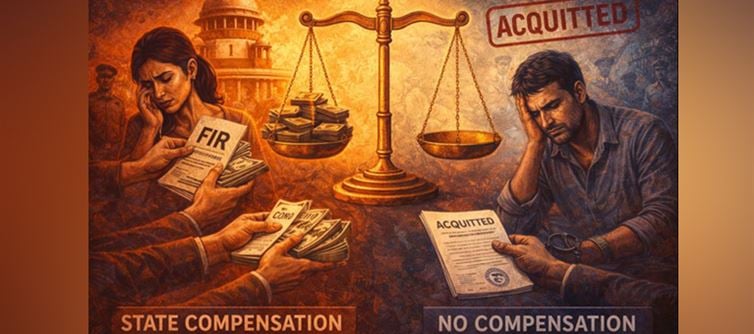
Justice systems are meant to protect the vulnerable and punish the guilty. But when safeguards operate in only one direction—when money, process, and sympathy flow without consequence—the law itself becomes unbalanced. In India, a woman who files a rape FIR can receive state compensation at multiple stages. If the case later collapses and the accused is acquitted as innocent, the compensation is not recovered, and the man receives nothing. That asymmetry isn’t compassion. It’s institutional bias.
🧨 The Structural Imbalance, Step by Step
1. Compensation at the Start, Middle, and End
Under victim compensation frameworks, money may be disbursed upon FIR registration, at chargesheet filing, and after conviction. The intent—support survivors—is legitimate. The execution—no correction mechanism—is not.
2. When the Case Is Proven False
Courts routinely acquit accused persons for lack of evidence, malicious prosecution, or demonstrable falsehoods. Yet the compensation already paid is never reassessed.
3. zero Redress for the Acquitted
The falsely accused man—who may have lost years, employment, reputation, and mental health—gets no automatic compensation, no restitution, no apology from the state.
4. Due Process Becomes One-Sided
Presumption of innocence exists on paper. In practice, punishment precedes proof—while remedies never follow acquittal.
5. Incentives Without Safeguards
A system that disburses funds without post-trial accountability risks perverse incentives—not because most complainants are dishonest (they aren’t), but because law must plan for misuse as rigorously as it plans for protection.
⚖️ What This Is—and What It Isn’t
This is not anti-women.
This is not victim-blaming.
This is a call for procedural symmetry: compassion with accountability; protection with correction.
Courts, including the Supreme Court of India, have repeatedly emphasised fairness and proportionality. Yet compensation policy lags behind jurisprudence.
🧠 The Human Cost We Don’t Count
6. Social Death Without Conviction
Even after acquittal, stigma sticks. Careers stall. Families fracture. The state moves on; the individual doesn’t.
7. Silence as Survival
Knowing there’s no remedy if falsely accused, many men avoid relationships, workplaces, or reporting—a chilling effect no just system should tolerate.
🧩 What Balanced Reform Looks Like
8. Post-Trial review of Compensation
Not automatic recovery—but judicial review where cases are proven false or malicious.
9. State Compensation for the Acquitted
When innocence is established, the state should compensate for wrongful prosecution—time lost, livelihood harmed, dignity damaged.
10. Penalties for Proven Malice, Not Error
Honest complaints that fail deserve protection. Malicious falsehoods, proven in court, deserve consequences. Distinguish clearly.
11. Gender-Neutral Language, Gender-Just Outcomes
Protection must be robust—and fair to all citizens. Equality before the law cannot be selective.
🧨 Closing Punch
Justice that only moves forward—and never corrects itself—isn’t justice.
Compassion without accountability breeds distrust.
Protection without balance undermines credibility.
If the law can compensate before proof, it must also compensate after innocence.
Anything less isn’t gender justice.
It’s institutional imbalance—and it’s time to fix it.
 click and follow Indiaherald WhatsApp channel