


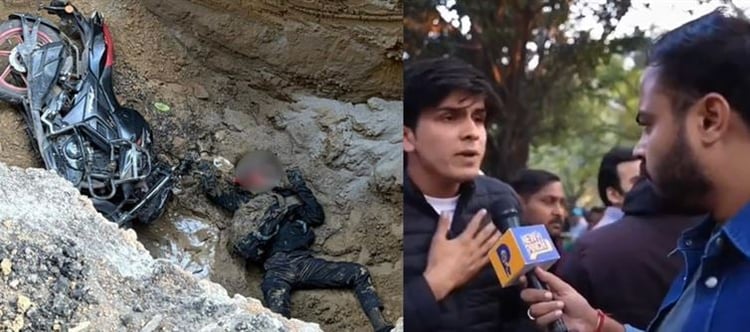

A Death, A Camera, A Flashpoint
A 25-year-old bank employee falls into an uncovered pit in delhi and loses his life. What should have been a somber reckoning over public safety instead morphs into a viral confrontation that’s now racing across social media.
As reporters criticized civic authorities over the exposed hazard, a young man identifying himself as MBA student Harsh Solanki stepped into frame — not to demand answers, but to redirect blame. According to the viral clip, he argued the victim’s family bore responsibility for giving him a bike. In the heat of the exchange, he even mischaracterized the deceased as a schoolchild.
The reporter’s stunned response cut through the chaos: it is this mindset, he argued, that allows leaders to escape scrutiny.
Within hours, the clip surged past 190,000 views.
And the outrage followed.
1️⃣ The Tragedy: An Open Pit, A Preventable Death
Uncovered construction pits and open drains have long been a recurring hazard in parts of indian cities, especially during monsoon seasons and ongoing infrastructure work.
The central question raised by journalists at the scene was simple:
Why was the pit left unsecured?
Public infrastructure carries public responsibility. When safety barriers fail — or are absent — the consequences are often irreversible.
2️⃣ The Deflection: Shifting Blame Downward
Instead of engaging with the civic lapse, the intervening speaker shifted focus to the victim’s family.
The logic stunned viewers: if the family had not given him a bike, he wouldn’t have been there.
It’s a form of argument that redirects institutional responsibility toward individual choice. Critics online called it deflection. Supporters saw it as personal accountability rhetoric.
But in matters of public safety, the debate isn’t philosophical — it’s structural.
Roads, drains, and construction sites: these fall under governance, regulation, and enforcement.
3️⃣ The Viral Effect: Mockery, Memes, and Moral Outrage
Social media rarely stays neutral.
Clips were trimmed and reposted. Comment sections filled with sarcasm and disbelief. The phrase “blame the parents” became shorthand for what many users saw as absurd reasoning.
The confrontation quickly expanded beyond the individuals involved. It became symbolic — a snapshot of polarized political discourse.
For critics, it represented blind loyalty overriding logic.
For defenders, it represented pushing back against one-sided media narratives.
Either way, the optics were explosive.
4️⃣ Infrastructure vs. Ideology
India is undergoing rapid urban expansion. Roads are dug up, cables laid, drains repaired. With that growth comes risk — especially when safety compliance slips.
But when tragedy occurs, the public conversation often pivots from engineering standards to political identity.
The deeper issue isn’t who won the street argument.
It’s whether civic accountability mechanisms function effectively. Are contractors monitored? Are barricades mandatory? Are inspections routine? Are penalties enforced?
When those questions are overshadowed by partisan shouting, systemic reform stalls.
5️⃣ The Broader Pattern
This isn’t the first time a fatal accident has sparked a blame game.
In polarized environments, tragedy can become a battleground. One side alleges administrative negligence. The other accuses of opportunistic politicization.
Meanwhile, grieving families remain at the center of a storm they never asked for.
The viral moment may fade.
But the uncovered pits remain.
The Final Reckoning
A young man is dead.
A street debate goes viral.
Timelines fill with mockery and rage.
But beneath the noise lies a blunt reality: public infrastructure failures are not abstract. They are physical. Concrete. Sometimes fatal.
The real question isn’t who won the argument.
It’s whether the next pit will be covered before someone else falls in.
 click and follow Indiaherald WhatsApp channel