


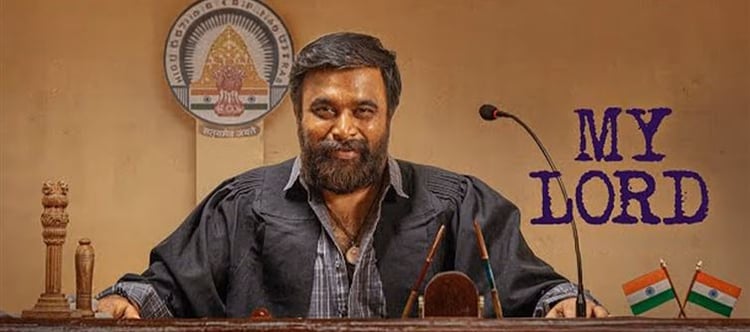

⚖️ Premise: Declared Dead, Yet Desperately Alive
With My Lord, director Raju Murugan once again dives into systemic injustice, packaging social critique within a plot-heavy narrative.
The film opens on a grim medical note — a Central minister (Asha Sarath) diagnosed with kidney failure. Parallelly, in a government hospital, we meet Muthusirpi (Sasikumar), a matchbox factory worker on the brink of suicide. His reason is absurd yet devastating: both he and his wife Suseela (Chaithra Achar) have been officially declared dead in government records. Death certificates issued. Identities erased.
What begins as bureaucratic horror soon spirals into a satirical drama about power, disposability, and the cruel mechanics of systems that operate without conscience.
📖 Story: When Paperwork Kills
muthu and Suseela’s ordeal begins with a medical emergency that pushes them toward a loan shark and eventually into administrative oblivion. Their identities are stolen, records wiped clean, and they are legally “dead.” Just as they struggle to reclaim existence, fate twists further — muthu turns out to be the only viable kidney match for the ailing minister.
A journalist (Guru Somasundaram) enters the fray, sensing injustice. Legal battles ensue. Political manipulation simmers. What unfolds is a commentary on how institutions treat the marginalised as expendable commodities.
The premise is undeniably compelling. It promises biting satire and moral confrontation. And for large stretches, the film delivers intrigue. But the deeper emotional resonance remains frustratingly out of reach.
🎭 Performances: Sincerity Without Surprise
Sasikumar plays Muthusirpi with characteristic restraint. He is believable, grounded, and easy to root for. His portrayal never feels exaggerated, and his sincerity anchors the narrative. However, the character’s moral rigidity — repeatedly rejecting life-changing offers — feels less like organic stubbornness and more like a screenplay insisting on nobility.
Chaithra Achar makes a confident tamil debut, bringing quiet strength to Suseela. She lends emotional weight without melodrama and shines particularly in culturally rooted sequences, including a temple possession scene that adds dramatic intensity.
Asha Sarath plays the minister with controlled dignity, though the writing gives her limited dimensionality. Guru Somasundaram, as the journalist, injects subtle urgency into the proceedings, yet even his character feels like a narrative device rather than a fully formed individual.
The recurring issue is that while the actors perform capably, the characters feel constructed rather than lived-in.
🎥 Technical Craft: Polished and Purposeful
Cinematographer Nirav Shah delivers visually restrained elegance. The frames are naturalistic, grounded in the texture of everyday tamil Nadu. There’s a deliberate avoidance of visual flamboyance, which suits the realism Raju Murugan aims for.
Sean Roldan provides an understated background score that enhances emotion without overwhelming it. The music knows when to step back, allowing the narrative tension to breathe — even if the screenplay sometimes does not.
Technically, My Lord is confident, measured, and polished.
🔍 Analysis: Satire That Stings, But Doesn’t Linger
Raju Murugan’s strength lies in exposing how casually power treats the powerless. The satire lands — particularly in dialogues that cut sharply into bureaucratic apathy. Scenes illustrating systemic indifference feel disturbingly real.
However, the film’s biggest weakness is emotional distance. The characters function like chess pieces in a well-planned political metaphor. The minister’s children deliver nearly identical emotional appeals. A morally ambiguous cop masquerading as a businessman remains frustratingly one-dimensional. Sharp gags sometimes stretch just a moment too long.
The narrative moves efficiently, but rarely pauses to let its people breathe.
Organ harvesting as a thematic backdrop is familiar territory, and while the film avoids sensationalism, it doesn’t reinvent the space either. The social commentary is effective — but it stops short of profound.
✅ What Works
• A compelling, socially relevant premise
• Sasikumar’s understated sincerity
• Chaithra Achar’s strong debut performance
• Nirav Shah’s polished cinematography
• Sean Roldan’s subtle, intelligent score
• Dialogues that occasionally sting with satirical bite
❌ What Doesn’t
• Characters feel symbolic rather than human
• Emotional beats are occasionally repetitive
• Moral stubbornness that feels scripted, not organic
• Supporting roles lacking grey complexity
• Familiar thematic territory without a fresh spin
🎯 Bottom Line
My Lord is a film with conviction. It knows what it wants to say and says it clearly. The satire works often enough to keep you engaged, and the performances are dependable. But for a story rooted in identity, dignity, and survival, it needed characters who linger in memory long after the credits roll.
Instead, it leaves you admiring the message more than the people delivering it.
It’s sincere. It’s sharp in parts. It just needed more life in its living.
 click and follow Indiaherald WhatsApp channel