


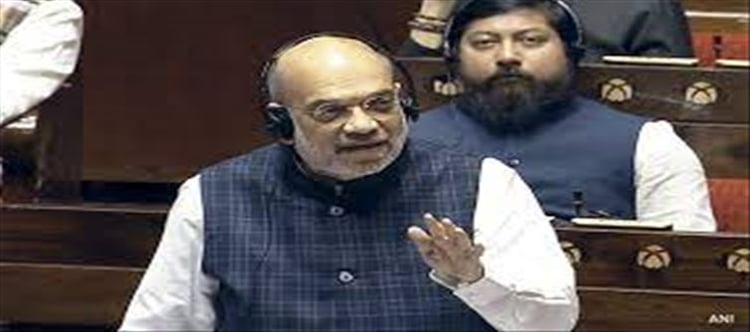

Accordingly as the winter session of parliament is underway, three key bills to amend the indian Penal Code, criminal Procedure Code and the indian Evidence Act were passed in the lok sabha on Wednesday. Responding to the debate on the three bills, Union home minister amit shah said these laws are in line with the spirit of the Constitution.
Bharatiya Nyaya (Second) Sanhita 2023
Bharatiya Nagarik Suraksha (Second) Sanhita 2023
Bharatiya Sakshya (Second) Bill 2023
These bills will amend the indian Penal Code-1860, criminal Procedure Code-1898 and the indian Evidence Act of 1872 respectively. Addressing the house yesterday, Union minister amit shah said that the proposed laws have been formulated after extensive consultations and every comma and full stop of the draft laws have been passed and they have been presented for approval.
It approaches terrorism as a crime, and defines terrorism as an act that threatens the integrity, security or economic security of the country, or strikes terror among people. This generally includes criminally organized crime such as kidnapping, extortion and cybercrime committed on behalf of crime syndicates.
A new offense has been created for acts prejudicial to the sovereignty, integrity and integrity of India. That is why 'Rajthro' was changed to 'Deshtro'. murder by five or more persons on account of a particular identity such as caste, language or personal belief is punishable by life imprisonment or death and a fine.
It is now mandatory for rape victims to record their statements on audio and video. The maximum penalty for "hit and run" is ten years in prison. However, the punishment is likely to be reduced if the offender takes the victim to the hospital or the police after the accident.
'Community service' is included as an alternative to imprisonment for many minor offences. Arrangements for zero FIR registration. The victim need not approach the jurisdictional police station; They can approach any police station. The FIR will be transferred to the appropriate police station within 24 hours.
The Bill seeks to amend the Code of criminal Procedure, 1973 (CrPC). A forensic investigation is mandatory for offenses punishable by a minimum sentence of seven years. Forensic experts visit crime scenes to collect forensic evidence and record the process.
The report of the medical examination of the victim of sexual harassment shall be sent by the medical examiner to the investigating officer within 7 days. If the accused has fled to avoid prosecution and there is no immediate possibility of his arrest, he may be tried and judged in his absence.
Fingerprints, voice samples and specimen signatures or signatures of persons involved in the case may be collected for investigation or legal proceedings. Samples may be taken from a person who has not been arrested. The bill outlines new concepts such as timelines for mercy petitions, a scheme for witness protection and allowing electronic methods for recording statements and gathering evidence.
The bill establishes strict deadlines for many procedural requirements. The police must submit their summons to the court within seven days of the first hearing. The investigation must be completed within 90 days of the filing of the charge sheet. And judgments in that case should be announced within 30 days.
Bharatiya Sakshya (Second) Bill 2023 : Highlights
The Bill has 170 sections as opposed to 167 sections in the earlier indian Evidence Act. Out of these 167 sections, 23 sections were modified, five were deleted and one more section was added. It replaces the indian Evidence Act, 1872 (IEA). It retains most of the IEA's rules, including affidavits, relevancy of facts and burden of proof.
The IEA offers two types of evidence – documentary and oral. Documentary evidence includes primary (original documents) and secondary (proving original content). The bill retains the distinction. It classifies electronic records as documents.
 click and follow Indiaherald WhatsApp channel