



Schoolchildren in Belagavi were allegedly sent door-to-door to collect voter data during the Summary Revision of electoral rolls (SIR), according to The Times of India. The District Commissioner has ordered a probe, while the BJP has approached the Election Commission alleging broader irregularities in Karnataka's voter roll revision — raising serious questions about child rights, administrative oversight, and the ruling party's ground-level election machinery.
Picture this: a twelve-year-old knocking on doors in a Belagavi neighbourhood, clipboard in hand, asking adults to verify their voter details. Not for a school project. For the state's official Summary Revision of electoral rolls. The image is so absurd it sounds like satire — except it apparently happened, and it tells you more about how Karnataka's election machinery actually works at ground level than any press conference ever could.
According to The Times of India, schoolchildren in Belagavi were allegedly deployed to conduct door-to-door voter data collection during the ongoing SIR exercise — a process that, by law and by Election Commission protocol, is supposed to be carried out by trained Booth Level Officers, typically government employees or supervised adults. The Belagavi District Commissioner has ordered a formal inquiry into the matter.
The Complaint, the Counter, and the Corridors
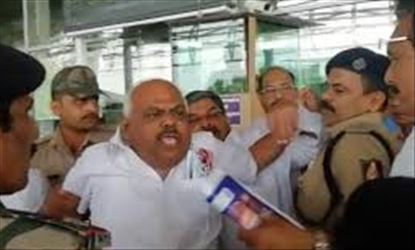
The BJP has not let this one pass quietly. The party has approached the Election Commission directly, alleging broader irregularities in Karnataka's voter roll revision process, with the Belagavi episode as exhibit A. BJP leader Prakash Joshi, according to The Times of India's separate report on the DC overseeing the SIR drive, has alleged interference and irregularities in the revision — framing it not as a one-off lapse but as a systemic pattern under the Congress-led state government.
The ruling Congress in Karnataka, for its part, has not issued a detailed public rebuttal on the Belagavi children episode as of this report. The DC's probe, while acknowledging the gravity of the allegation, remains at its preliminary stage. No individual official has been publicly named as having given the order.
That silence — who gave the order — is itself the loudest part of the story.
Political Pulse
The corridors in Belagavi are buzzing with a question nobody in the ruling dispensation wants to answer on record: was this a local tahsildar-level improvisation born of staff shortages, or did someone higher up quietly nod because the SIR needed to be done fast and the BLO bench was thin? The talk in administrative circles, as India Herald reads it, is that the chronic underfunding of the BLO infrastructure — temporary appointments, poor pay, reluctant government schoolteachers doubling up — has created a system where desperate shortcuts become normalised. Using schoolchildren is the most visible symptom of a rot that runs much deeper.
Opposition insiders are calling this a gift-wrapped weapon. In a border district like Belagavi — where Marathi-Kannada linguistic tensions, the Maharashtra Ekikarana Samiti factor, and finely balanced caste arithmetic make every voter roll addition or deletion politically combustible — the suggestion that minors were used to handle sensitive electoral data is incendiary. The whisper in BJP circles is that this will be weaponised not just for the upcoming panchayat elections but stockpiled for the next assembly cycle, framed as proof that the Congress government treats electoral processes as casual errands to be farmed out to whoever is available, including children.
The Congress camp's quieter worry, according to those tracking party dynamics in north Karnataka, is different: that this episode hands the BJP a child-rights narrative — always potent in media and in courts — at a time when the Siddaramaiah government is already defending itself on multiple governance fronts. A child-rights angle has a universality that transcends partisan lines; it is the kind of story that mothers and fathers across party loyalties react to viscerally.
Why Belagavi Is Not Just Any District
Belagavi is Karnataka's most politically layered border district. It is the seat of the Suvarna Vidhana Soudha, the site of perennial Maharashtra-Karnataka boundary disputes, and a constituency cluster where assembly margins are razor-thin. Voter roll exercises in such regions carry outsized weight — every name added or deleted can shift arithmetic in wards and panchayats. That children were allegedly handling this data — names, addresses, family details — in such a district is not just an administrative failure; it is a security and privacy breach of the first order.
Consider the parallel: if schoolchildren in, say, a municipal ward of Bengaluru were found collecting Aadhaar-linked voter data door-to-door, the outrage would be instantaneous and national. In Belagavi, the story risks being buried under the district's perpetual border-politics noise — which is precisely why it deserves sharper scrutiny.
The Child Rights Dimension
India's Right to Education Act and the Child Labour (Prohibition and Regulation) Act set clear boundaries: children are not to be employed in activities that interfere with their education or expose them to hazards. While voter data collection might not involve physical danger, deploying minors for government administrative work during school hours — if that is what occurred — raises questions under both statutes. The National Commission for Protection of Child Rights (NCPCR) has, in past instances involving other states, taken suo motu cognisance of far milder infractions. Whether this case reaches that threshold depends on what the DC's probe uncovers and whether the BJP or civil society organisations escalate it beyond the state.
India Herald's Forward Read
India Herald's assessment is that this episode is structurally significant beyond the immediate scandal. It exposes the gap between the Election Commission's meticulously designed SIR protocols — trained BLOs, supervised verification, chain-of-custody data handling — and the ground reality in understaffed, overstretched district administrations across Karnataka and, frankly, across India. The DC's probe will likely identify a local-level order or an informal directive; what it is unlikely to do is address the systemic BLO shortage that made the shortcut thinkable.
Watch for two things in the coming weeks. First, whether the BJP formally moves the NCPCR or a court — converting this from a political allegation into a legal proceeding that the Congress cannot dismiss as election-season noise. Second, whether similar ground-level improvisations surface in other Karnataka districts during this SIR cycle, turning a Belagavi anecdote into a statewide pattern. If either happens, the Siddaramaiah government will find itself defending not just a lapse but a governance philosophy — and doing so on the one terrain, child welfare, where no political spin survives contact with a voter who is also a parent.
The question that should keep Karnataka's ruling establishment awake is not who gave the order in Belagavi. It is how many other Belagavis are out there, clipboard in a child's hand, waiting to be photographed.
Allegations reported here are attributed to named sources and remain unproven unless a court has ruled; matters sub judice are reported without prejudgment.
Reported and written with AI assistance under India Herald's editorial standards; a human editor governs publication.
More from India Herald


Key Takeaways
- Schoolchildren in Belagavi were allegedly deployed for door-to-door voter data collection during the official Summary Revision of electoral rolls, a task legally meant for trained Booth Level Officers — the DC has ordered a probe, according to The Times of India.
- The BJP has escalated the matter to the Election Commission, alleging systematic irregularities in Karnataka's voter roll revision, framing it as a governance failure under the Congress-led state government.
- The episode exposes a deeper crisis: chronic understaffing of BLO infrastructure across Karnataka, where temporary appointments and reluctant government teachers create conditions for desperate shortcuts.
- Belagavi's political sensitivity — border disputes, razor-thin assembly margins, linguistic tensions — makes any voter roll irregularity combustible; this incident hands the opposition a child-rights narrative that transcends partisan lines.
- India Herald's forward read: watch whether the BJP moves the NCPCR or courts, and whether similar improvisations surface in other districts — either could convert a local lapse into a statewide governance crisis for the Siddaramaiah government.
By the Numbers
- Belagavi schoolchildren allegedly used for SIR voter data collection — a task legally designated for trained adult Booth Level Officers, per Election Commission protocol.
- The BJP has formally approached the Election Commission over alleged irregularities in Karnataka's voter roll revision, per The Times of India.
The 5W+H: Who, What, When, Where, Why, How
- Who: Schoolchildren in Belagavi district, allegedly deployed by local administrative or educational authorities; BJP leader Mahantesh Koujalagi and other opposition figures who flagged the issue; the Belagavi District Commissioner who ordered a probe, according to The Times of India.
- What: Minor students were reportedly used to conduct door-to-door data collection as part of the Summary Revision of voter rolls (SIR) in Belagavi, prompting an official probe and a BJP complaint to the Election Commission.
- When: The allegations surfaced in the ongoing SIR cycle in mid-2026, with the DC-ordered probe announced as reported by The Times of India.
- Where: Belagavi district, Karnataka — a politically sensitive border district with a history of intense linguistic and electoral contestation.
- Why: The alleged use of children points to a shortage of trained Booth Level Officers (BLOs) or a breakdown in administrative protocols during the voter roll revision, with the opposition alleging deliberate irregularities to manipulate electoral rolls ahead of panchayat and assembly cycles.
- How: According to reports, schoolchildren were tasked with visiting households to verify and collect voter data — work legally mandated for trained government officials — apparently under the direction of local school or administrative authorities, the specifics of which the DC's probe is expected to clarify.
Frequently Asked Questions
What happened with schoolchildren and voter rolls in Belagavi?
According to The Times of India, schoolchildren in Belagavi were allegedly deployed to collect voter data door-to-door during the official Summary Revision of electoral rolls (SIR), a task legally meant for trained Booth Level Officers. The District Commissioner has ordered a probe.
What is the Summary Revision of electoral rolls (SIR)?
The SIR is the Election Commission of India's periodic exercise to update voter rolls — adding eligible voters, removing deceased or shifted ones, and correcting details. It is conducted by trained Booth Level Officers through door-to-door verification.
Has the BJP taken action on the Belagavi voter roll issue?
Yes. According to The Times of India, the BJP has approached the Election Commission alleging broader irregularities in Karnataka's voter roll revision process, with the Belagavi episode as a key example.
Could there be legal consequences under child rights laws?
Deploying minors for government administrative work could potentially raise questions under the Right to Education Act and the Child Labour (Prohibition and Regulation) Act. Whether the NCPCR or courts take up the matter depends on the DC probe's findings and whether political or civil society actors escalate it.
 click and follow Indiaherald WhatsApp channel