
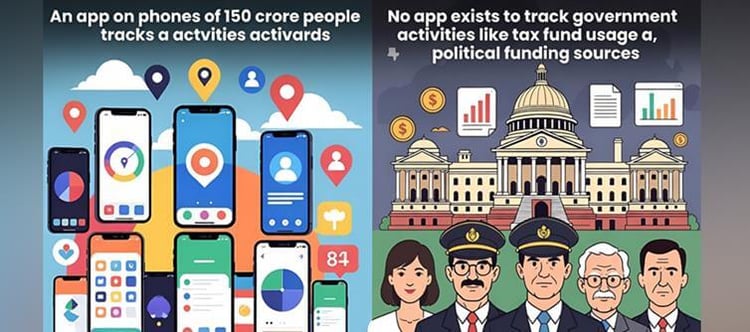


⚡A COUNTRY WHERE ONLY ONE SIDE GETS TO WATCH
A government telling 150 crore citizens:
“Install this app, let us monitor your activity. It’s for your safety.”
Meanwhile, citizens ask a simple question:
“Okay… so where is the app to monitor YOU?”
Silence.
india is entering an era where public surveillance is mandatory, but government transparency is optional.
Where citizens must constantly prove trustworthiness, but leaders never have to.
Where the voter is watched like a suspect, but the elected operate like ghosts.
Welcome to the new wallet PLATFORM' target='_blank' title='digital-Latest Updates, Photos, Videos are a click away, CLICK NOW'>digital contract — A one-way mirror where only one side can see the other.
💥 1. THE government WANTS TO TRACK YOU — BUT WON’T LET YOU TRACK THEM
Mandatory apps.
SIM-linked verification.
Whitelisted platforms.
Forced wallet PLATFORM' target='_blank' title='digital-Latest Updates, Photos, Videos are a click away, CLICK NOW'>digital compliance.
But when it comes to:
exact breakdowns of how tax money is spent, who funds political parties,
how decisions are made,
who gets government contracts,
where budget allocations really go,
Suddenly, the transparency crusade evaporates.
Citizens get surveillance.
Government gets invisibility.
The balance is broken.
🔍 2. THE TAXPAYER’S BURDEN — PAY, GET TRACKED, STAY QUIET
Indians pay taxes directly or indirectly every single day:
GST. Income tax. Fuel tax. Road tax. Telecom tax. Hidden cess.
But ask for a public dashboard showing:
How much tax money goes to welfare
How much for infrastructure
How much for political advertising
How much to “miscellaneous expenses?”
And suddenly the system freezes.
Transparency is treated as a threat — when it should be a right.
Citizens are expected to trust blindly while being monitored constantly.
It’s the biggest power imbalance in a democracy.
⚠️ 3. POLITICAL FUNDING — THE BIGGEST BLACK BOX OF ALL
You’re tracked down to your SIM card.
But the government doesn’t have to disclose:
Who funds political parties
How much money do they get
What favours are exchanged
Who gets influence
Who buys access
Who controls the agenda
Citizens are audited.
Parties are not.
It’s hypocrisy disguised as policy.
The world’s largest democracy has one of the world’s darkest political money systems.
🧨 4. WHY DOES THE government DISTRUST people — BUT DEMAND people TRUST GOVERNMENT?
If the government genuinely trusted citizens,
it wouldn’t mandate compulsory tracking tools.
If citizens genuinely trusted the government,
they wouldn’t be asking for transparency apps.
Democracy is supposed to be mutual accountability.
But right now, the relationship looks like this:
Government → Full surveillance
People → zero visibility
Trust cannot survive when it flows only one way.
💣 5. POWER WITHOUT ACCOUNTABILITY ALWAYS BECOMES ABUSE
History has shown this again and again:
Any system that allows monitoring of citizens without monitoring of the state becomes dangerous.
When the public can be watched but cannot watch back, democracy becomes ornamental —
A label, not a safeguard.
Transparency isn’t a luxury.
It’s the only thing standing between governance and authoritarian drift.
🔥 CONCLUSION — IF SURVEILLANCE IS MANDATORY, TRANSPARENCY MUST BE TOO
If the government can mandate:
tracking apps,
SIM binding,
wallet PLATFORM' target='_blank' title='digital-Latest Updates, Photos, Videos are a click away, CLICK NOW'>digital logs,
device monitoring…
Then citizens have the right to mandate:
expenditure tracking,
political funding transparency,
project updates,
real-time public dashboards,
audits available to everyone.
Because democracy is not a one-way contract.
If citizens must trust the government with their data…
The government must trust citizens with the truth.
Otherwise, this isn’t surveillance for safety.
It’s surveillance for control.
And india deserves better.
 click and follow Indiaherald WhatsApp channel