


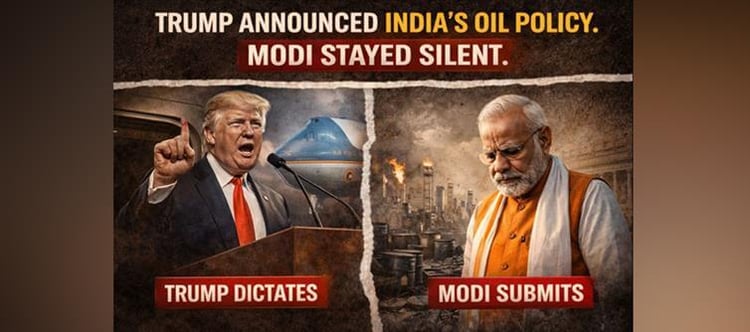

⚡ THE ANNOUNCEMENT THAT DIDN’T COME FROM NEW DELHI
In global politics, who speaks first matters. It signals authority, ownership, and sovereignty. So when Donald Trump publicly spoke about India’s oil direction—before any confirmation from New Delhi—the optics were brutal. Not because foreign leaders never comment on partners’ policies, but because India didn’t answer back.
No clarification.
No rebuttal.
No assertion of autonomy.
Just silence—loud enough to raise a single, uncomfortable question: Who decides India’s energy choices?
1️⃣ ENERGY SOVEREIGNTY IS NOT A FAVOR — IT’S A RIGHT
Energy imports aren’t lifestyle choices. They are strategic decisions tied to inflation, food prices, industry competitiveness, and national security.
When a foreign leader frames those choices publicly—whether accurately or aspirationally—the home government must respond. Silence invites the assumption that consent has already been given.
In geopolitics, unchallenged statements harden into “understandings.”
2️⃣ FROM TARIFF PRESSURE TO POLICY SIGNALS
Reports and rhetoric around tariffs, sanctions pressure, and “preferred suppliers” have circulated for months. Whether or not every detail is final, the pattern is familiar:
Pressure first
“Expectations” second
Public statements third
If India’s choices are being discussed as faits accomplis, the damage isn’t just economic—it’s reputational. Partners begin to believe india can be brought into compliance.
3️⃣ THE PROBLEM ISN’T oil — IT’S THE PRECEDENT
This debate isn’t about russia vs venezuela vs Iran.
It’s about process.
A sovereign state:
Announces its own policy
Frames its own rationale
Defends its own interests
When that sequence flips—when policy appears to be previewed abroad and explained at home later—the message to the world is corrosive: India reacts; others declare.
4️⃣ SILENCE IS NOT STRATEGIC AMBIGUITY
Supporters will argue that quiet diplomacy avoids escalation. Sometimes that’s true.
But silence without subsequent clarification isn’t a strategy—it’s abdication. Strategic ambiguity works only when both sides understand the boundaries. Here, the boundary looked erased.
In energy markets, ambiguity raises costs. Traders price risk. Allies hedge. Adversaries probe.
5️⃣ A CLIENT-STATE OPTIC india CAN’T AFFORD
Words like “vassalage” sting because they describe optics, not treaties.
No one is claiming formal loss of sovereignty. But optics shape leverage. When announcements about India’s choices precede India’s voice, leverage shifts away—quietly, persistently.
And once that perception settles, reversing it is far harder than preventing it.
6️⃣ WHAT STRONG LEADERSHIP WOULD HAVE LOOKED LIKE
A single, firm response would have sufficed:
Reaffirm India’s sovereign right to decide energy imports
State that decisions are based on price, reliability, and national interest
Clarify that no foreign announcement substitutes for indian policy
That’s not confrontation. That’s self-respect.
🧨 FINAL WORD: NATIONAL INTEREST NEEDS A VOICE
This isn’t anti-America.
This isn’t pro-any supplier.
This is pro-India.
A nation of India’s size and ambition cannot afford moments where others narrate its choices. Leadership is not about avoiding discomfort—it’s about owning decisions publicly.
Because in global politics, when you don’t speak for yourself, someone else always will.
 click and follow Indiaherald WhatsApp channel