


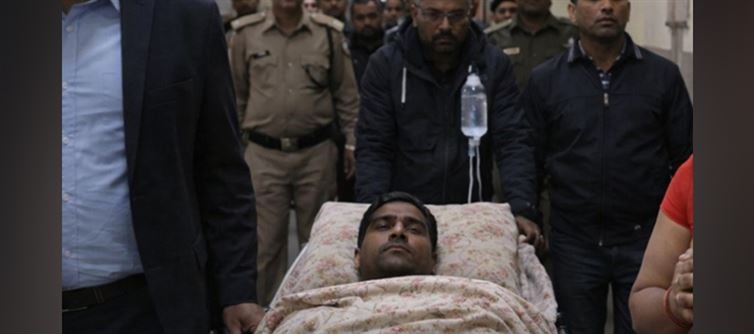
 Husband Brought on a Stretcher to Prove He’s Not Lying - Paralyzed, Speechless, and Dragged to Court
⚖️ JUSTICE ON A STRETCHER
When the Law Loses Its Humanity, Everyone Loses
🔥 1. A Courtroom Scene That Should Never Exist
In a maintenance proceeding meant to ensure dignity and survival, a man was produced before the court on a stretcher—paralysed, non-communicative, unable to sit, walk, speak, or even perform basic bodily functions. Bedridden for nearly five years after a devastating brain haemorrhage, the left side of his body completely non-functional, he lay there as living proof of a system that had stopped seeing and started processing.
🧠 2. The Medical Reality No One wanted to Acknowledge
This was not a case of inconvenience or exaggeration. Medical records, hospital documents, and photographs had already been placed on record. The condition was established, documented, and undisputed in evidence—except where it mattered most. Despite this, the wife allegedly claimed before the court that he was “completely healthy” and deliberately avoiding proceedings.
💔 3. A marriage That Lasted a Month, Litigation That Lasted Years
According to the family, the marriage collapsed within a month. What followed was not reconciliation or resolution, but a cascade of legal proceedings: a case under Section 498A IPC, followed by a maintenance petition. Years passed. His health collapsed. The litigation did not pause.
🚓 4. When Procedure Turns Into Pressure
Because of developments in the 498A case—where he was declared an absconder—coercive steps under Sections 82 and 83 CrPC were proposed. The police allegedly warned the family: produce him physically or face property attachment. No nuance. No discretion. No humanity.
So the family did the unthinkable. They brought a paralysed, non-communicative man to court on a stretcher—not to seek sympathy, but to avoid punishment.
🪦 5. Proof by Suffering
Only after seeing him in person did the court reportedly take note of his condition. That single moment exposes the rot. When documentary medical evidence is already on record, forcing physical production is not verification—it is ritual humiliation. It asks a man to suffer publicly to earn credibility privately.
⚖️ 6. Maintenance Law Is Not a Weapon
Maintenance law exists to prevent destitution—not to deny reality. It is meant to protect the vulnerable, not to become a blunt instrument disconnected from facts. When a paralysed man who cannot speak or move is treated as a willful defaulter, the law is no longer protective—it is punitive.
🧱 7. criminal Procedure Is a Means, Not an End
criminal procedure exists to secure justice, not to mechanically grind families into compliance. When the system insists on physical presence even when it serves no legal purpose, procedure stops being a safeguard and becomes cruel, wearing a uniform.
🛑 The Uncomfortable Question
If a paralysed man must be wheeled into court on a stretcher to be believed, what does that say about our idea of justice?
This case isn’t just about maintenance.
It’s about proportionality without empathy, process without purpose, and a legal system that forgot its first principle: justice is meant to protect human dignity, not suspend it.
Because when the law demands proof in pain, the system itself stands indicted.
 click and follow Indiaherald WhatsApp channel