


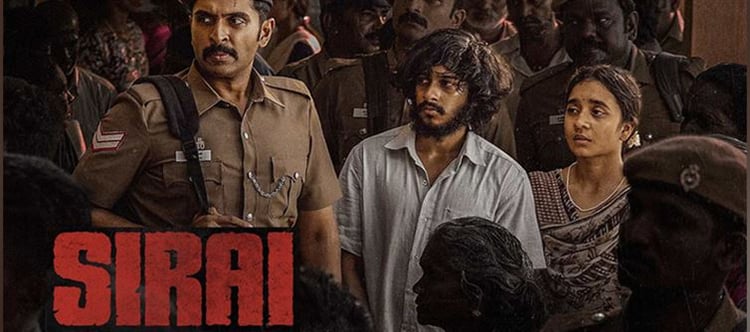

SIRAI movie REVIEW: A QUIETLY DEVASTATING police PROCEDURAL THAT HITS WHERE IT HURTS
Cast: Vikram Prabhu, Akshay Kumar
Writer: Thamizh
Genre: police Procedural | Social Drama
Runtime: ~2 hours
A journey THAT FEELS LIKE A TRIAL—FOR EVERYONE INVOLVED
Some films shout about injustice. Sirai whispers—and that whisper lingers far longer. Set in the late 1990s, this police procedural is not interested in chest-thumping heroics or stylised brutality. Instead, it follows a seemingly routine escort duty that slowly morphs into a moral crucible. By the time the journey ends, Sirai leaves behind equal measures of pain and hope, making it one of the most quietly powerful tamil films of 2025.
STORY: WHEN DUTY, HUMANITY, AND PREJUDICE COLLIDE
Kathiravan (Vikram Prabhu), an experienced AR police officer, is assigned to escort accused Abdul Rauf (debutant Akshay Kumar) from Vellore Central Prison to Sivagangai court along with two fellow officers. What should have been a procedural transfer turns into an emotionally charged passage through systemic bias, moral ambiguity, and institutional rigidity.
Abdul stands accused of murder, yet the film makes it clear that the real burden he carries is his name—and everything society assumes because of it. A pivotal scene where Abdul rehearses how to speak before the judge becomes the emotional backbone of Sirai. He isn’t lying. He isn’t manipulating. He is simply learning how to sound deserving of justice. That alone says everything the film wants to convey about structural prejudice.
SCREENPLAY & DIRECTION: REALISM OVER RHETORIC
Writer Thamizh (of Taanakkaran fame) once again proves his strength lies in restraint. The screenplay unfolds through lived-in moments—checklists, procedures, silences, glances—rather than overt monologues. The film patiently shows what it actually means to end up in sirai (jail), refusing to skip the mundanity of the process because that mundanity is precisely where injustice hides.
Much like Taanakkaran, the narrative avoids a bird’s-eye moral lecture. Instead, it places the audience inside the system and forces them to confront their own assumptions—especially about a man named Abdul.
PERFORMANCES: RESTRAINT MEETS raw VULNERABILITY
vikram Prabhu delivers one of his most controlled performances to date. Kathiravan is competent, experienced, and often the de facto leader—but the film never glorifies him. His quiet internal conflict, especially when duty begins to clash with conscience, is portrayed with admirable subtlety.
Akshay Kumar is the revelation. In his debut, he portrays Abdul with heartbreaking vulnerability and quiet inner strength. His eyes are innocent, fear in his body language, and dignity in his silences. His performance never begs for sympathy—and that’s what makes it devastating.
Supporting characters, including Kathiravan’s wife (also a cop), the escorting officers, and the judges representing two faces of the judiciary, are written with care and purpose.
TECHNICALITIES: TIGHT, PURPOSEFUL, AND UNSHOWY
The editing deserves special praise. At just around two hours, Sirai packs in themes of judicial injustice, police hierarchy, minority prejudice, domestic abuse, and institutional decay without ever feeling cluttered. Cinematography keeps things grounded and observational, avoiding unnecessary stylisation. The background score is minimal, allowing silence and ambient sound to do the emotional heavy lifting.
ANALYSIS: A FILM THAT TRUSTS ITS AUDIENCE
What makes Sirai exceptional is its refusal to offer easy answers. It asks uncomfortable “what if” questions—and sometimes even answers them brutally. What if Kathiravan wasn’t the escort? What if the judiciary failed again? What if the system chose convenience over conscience?
The film balances hope and pain delicately. It shows what police and judiciary can be at their best, while never shying away from how often they fail due to corruption, ignorance, or prejudice. This duality is what makes Sirai feel painfully real.
WHAT WORKS
• A tightly written, grounded screenplay
• Powerful debut performance by Akshay Kumar
• Vikram Prabhu’s restrained, mature acting
• Honest portrayal of systemic prejudice
• No glorification of police brutality or heroism
• Crisp editing and realistic procedural detailing
WHAT DOESN’T
• The slow-burn approach may test impatient viewers
• Minimal hand-holding demands emotional engagement
• Some may expect louder political commentary
BOTTOM LINE
Sirai is not a film that screams for attention—it earns it. With its sharp writing, humane performances, and deeply rooted realism, it stands as one of the finest police procedurals in recent tamil cinema. It doesn’t exploit pain, nor does it sell false hope. Instead, it holds up a mirror—quietly, firmly, and honestly.
This is a cinema that trusts intelligence over impulse.
 click and follow Indiaherald WhatsApp channel