


Few brands in india carry the emotional weight of Amul. It isn’t just dairy — it’s cooperative pride, White Revolution legacy, and decades of household trust.
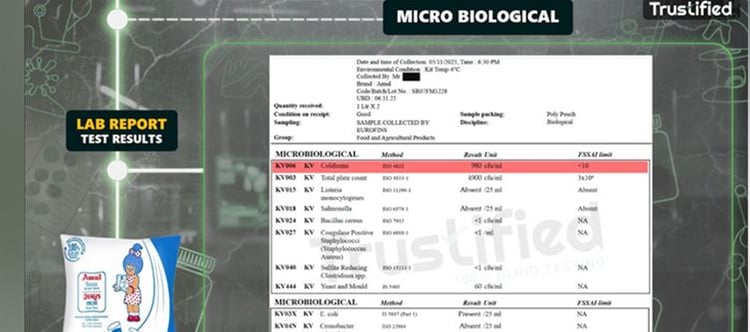
So when reports surfaced claiming that certain Amul dahi samples allegedly contained 2100 times more coliform bacteria and 60 times more yeast and mould than prescribed limits — followed by claims of milk containing 98 times higher coliform levels — shock quickly turned into outrage.
But outrage must be separated from evidence. Because in matters of food safety, facts matter more than fury.
Let’s break this down clearly.
🧪 1. What Are Coliforms — And Why Do They Matter?
Coliforms are bacteria commonly found in soil, water, and the intestines of humans and animals.
Their presence in processed milk or curd does not automatically mean dangerous pathogens are present. However, high counts can indicate poor hygiene during production, contamination during handling, or storage issues.
The real concern is indirect:
If coliform levels are elevated, the probability of other harmful bacteria may increase.
For vulnerable groups — infants, the elderly, pregnant women, and immunocompromised individuals — microbial contamination risk carries greater consequences.
📊 2. Who Conducted the Tests?
The reported results come from Trustified, an independent indian lab-testing platform that claims to use accredited microbiological labs.
According to their statements:
Multiple dahi pouch variants showed repeated exceedances.
Milk test findings are recent and reportedly consistent.
However:
Food Safety and Standards Authority of india (FSSAI) has not publicly confirmed these findings yet.
No official enforcement action has been announced at this time.
Amul has disputed at least the dahi findings, citing possible sampling or handling errors.
This is where caution is critical.
Lab results can vary based on:
Storage temperature before testing
Transportation delays
Batch differences
Sampling contamination
Without regulatory confirmation, conclusions remain provisional.
🏛 3. If True, The Implications Are Huge
If an established brand exceeded FSSAI microbial limits by such margins, it would raise urgent questions:
Were internal quality checks failing?
Was cold chain integrity compromised?
Were specific batches affected or systemic processes flawed?
But again — “if true” is doing heavy lifting here.
Regulatory verification is essential before drawing systemic conclusions.
🔥 4. Is indian Food Safety “Broken”?
It’s easy to spiral into sweeping declarations like “nothing is safe anymore.”
india does face recurring food adulteration challenges — milk dilution, synthetic products, and hygiene lapses. That’s documented.
But india also runs one of the world’s largest dairy supply chains under cooperative models serving hundreds of millions daily.
Food safety enforcement challenges often stem from:
Massive supply chain scale
Fragmented cold storage systems
Regional compliance gaps
That doesn’t excuse failures. It explains complexity.
🌍 5. The european Import Argument
Calls to allow european dairy imports stem from consumer choice arguments.
The EU operates under strict traceability and hazard analysis systems. However:
Even europe has faced dairy recalls and contamination incidents.
Imports do not automatically eliminate risk.
They would significantly impact indian dairy farmers and cooperative ecosystems.
This becomes not just a safety issue — but an economic and policy debate.
⚖️ 6. Consumer Rights vs producer Protection
You raise a key consumer-rights principle:
Consumers deserve safe food and transparent testing.
At the same time, accusations must be verified before declaring entire systems corrupt or malicious.
Food safety discourse should push for:
Public disclosure of batch testing
Third-party cross-verification
Rapid regulatory review
Transparent response from the brand
That strengthens trust — not weakens it.
🧠 7. The Most Important Next Step
Right now, the situation sits at a crossroads:
Independent lab claims exist.
The brand disputes at least part of them.
The regulator has not yet issued a conclusive statement.
What’s needed next isn’t outrage — it’s clarity.
Transparent retesting.
Regulatory communication.
Batch-specific disclosures.
Because when it comes to milk — something consumed daily by children and families — even uncertainty shakes confidence.
The Bottom Line
Is india a “durability test for humans”? That frustration reflects consumer anxiety.
But panic without verification helps no one.
If the reported figures are confirmed, accountability must follow swiftly.
If they are disproven, public trust must be restored just as loudly.
Food safety isn’t about nationalism.
It’s about microbiology, regulation, and transparency.
And right now, transparency is the only thing that can calm this storm.
 click and follow Indiaherald WhatsApp channel