


A Second Can Mean the Difference Between Life and Death
Severe bleeding doesn’t wait. In the first few minutes after a traumatic injury — whether from a gunshot, car crash, fall, or battlefield blast — uncontrolled hemorrhage is often the deciding factor between survival and tragedy.
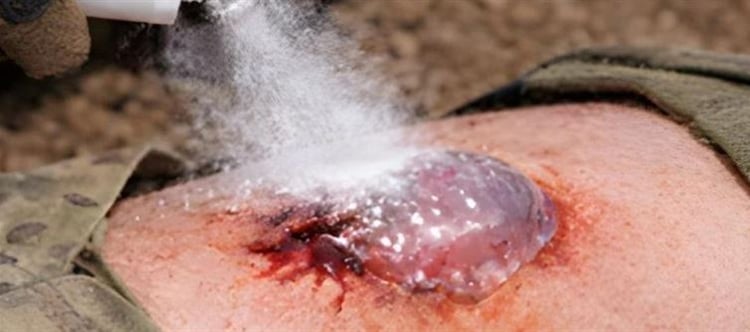
Now, scientists at Korea Advanced Institute of Science and Technology (KAIST) say they’ve created something that could buy those critical seconds back: a spray-on powder that transforms into a wound-sealing gel almost instantly upon contact with blood.
Published in Advanced Functional Materials, the research describes a next-generation hemostatic agent that could fundamentally change emergency care.
1️⃣ The Problem: Bleeding Kills Fast
Hemorrhage is one of the leading causes of potentially survivable deaths after trauma.
According to data cited by public health authorities, tens of thousands die annually from preventable bleeding. In combat settings, hemorrhage accounts for the vast majority of potentially survivable battlefield fatalities.
The brutal truth: you can survive a catastrophic injury — if bleeding stops in time.
But time is exactly what’s missing in remote environments, war zones, disaster sites, and highways far from hospitals.
2️⃣ The Breakthrough: Powder That Becomes a Gel in a Blink
KAIST researchers developed a spray-on powder that reacts with blood in less than a second.
The moment it touches blood, it transforms into a soft, flexible gel that:
• Conforms to irregular, jagged, or deep wounds
• Seals the injury site rapidly
• Promotes fast clot formation
• Absorbs up to seven times its weight in blood
Traditional gauze and bandages rely on pressure and time. This technology relies on chemistry and speed.
In emergency medicine, seconds matter more than sophistication.
3️⃣ The Science: Nature Does the Heavy Lifting
The compound — called AGCL — isn’t synthetic in the traditional sense. Its core ingredients come from nature:
• Alginate – extracted from brown seaweed
• Gellan gum – produced through bacterial fermentation
• Chitosan – derived from crustacean and insect shells
Alginate and gellan gum create the structural gel matrix. Chitosan enhances clotting by attracting red blood cells and platelets, accelerating aggregation at the wound site.
The result: a mechanically strong, flexible seal that doesn’t damage surrounding tissue and carries natural antibacterial properties.
This isn’t just rapid. It’s biologically intelligent.
4️⃣ Built for Chaos
The spray is being developed primarily for military and emergency responders — environments where:
• Evacuation may take hours
• Weather conditions are extreme
• Medical infrastructure is limited
• Injuries are severe and unpredictable
But its simplicity opens the door to broader applications:
• Ambulances
• Disaster relief kits
• Wilderness rescue packs
• Potential future civilian first-aid use
Even more striking: it can be stored for up to two years at room temperature and remains effective in hot, humid, or harsh environments.
Durability meets urgency.
5️⃣ A Mission Behind the Science
Kyusoon Park, one of the KAIST scientists behind the development, framed the research as more than innovation.
“The core of modern welfare is minimizing the loss of human life,” he stated, emphasizing a mission-driven approach to saving even one more soldier.
That philosophy extends beyond defense.
If scalable and approved for widespread use, the technology could influence civilian trauma care worldwide.
6️⃣ What Comes Next?
The organization has not yet announced a commercial release timeline.
Before widespread deployment, further validation, regulatory approvals, and large-scale testing will determine:
• Safety across diverse wound types
• Long-term tissue response
• Effectiveness in real-world emergency scenarios
But the early promise is hard to ignore.
The Bigger Picture
Modern medicine has conquered infections, extended lifespans, and engineered robotic surgery.
Yet one of the oldest threats to human survival — bleeding — still claims lives in minutes.
If this spray performs as research suggests, it won’t just be another medical product.
It could become a frontline defense against one of trauma’s fastest killers.
In emergency medicine, survival often hinges on a single decision made in seconds.
Now, it may hinge on a single spray.
 click and follow Indiaherald WhatsApp channel