
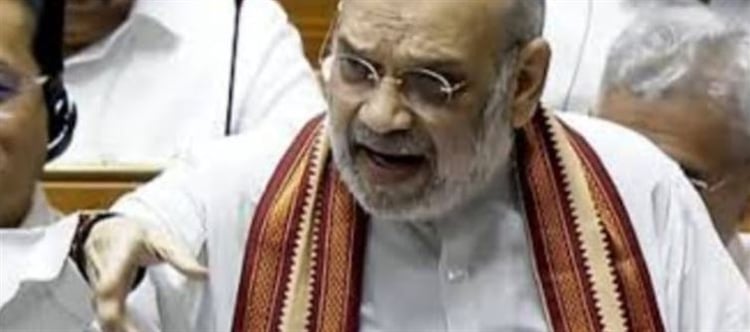


A heated exchange occurred in the rajya sabha during the Winter Session over the national song Vande Mataram.
The dispute escalated between the bjp, led by Union home minister amit shah, and the congress, represented by leader of the Opposition mallikarjun Kharge.
🔹 amit Shah’s Claims Against Congress
Shah accused congress of following “appeasement politics”, claiming it limited and divided Vande Mataram for political gain.
He asserted that:
“Tukde-tukde” (division) of Vande Mataram by congress contributed to India’s Partition.
If the national song had not been restricted for appeasement reasons, Partition might have been avoided.
Shah argued that:
Congress leadership, from jawaharlal nehru onward, has repeatedly opposed the national song.
During Vande Mataram’s 50-year commemoration, the congress allegedly “limited” the song.
He also criticised:
Indira Gandhi’s Emergency, claiming she jailed those who promoted Vande Mataram when it completed 100 years.
The gandhi family’s absence during lok sabha discussions on the subject.
🔹 Kharge’s Counterattack on the BJP
Mallikarjun Kharge rejected Shah’s remarks and accused the bjp of distorting history.
He defended Congress’s legacy, stating:
Vande Mataram was a key slogan during the freedom struggle, popularised by congress members.
Thousands were imprisoned shouting Vande Mataram during the Non-Cooperation Movement of 1921.
Kharge criticised the bjp leadership for:
Repeated attacks on jawaharlal nehru and other national leaders.
Targeting the congress despite its central role in securing independence.
He challenged the BJP’s moral standing by suggesting:
While congress members actively fought the British, “you were working for the Britishers.”
🔹 Core Political Fault Line
The clash reflects a broader ideological fight between the bjp and congress over:
Interpretation of the freedom struggle history
Ownership of national symbols
Allegations of appeasement vs. patriotism
Disclaimer:
The information contained in this article is for general informational purposes only. While we strive to ensure accuracy, we make no warranties or representations of any kind, express or implied, about the completeness, accuracy, reliability, suitability, or availability of the content. Any reliance you place on the information is strictly at your own risk. The views, opinions, or claims expressed in this article are those of the author and do not necessarily reflect the official policy or position of any organization mentioned. We disclaim any liability for any loss or damage arising directly or indirectly from the use of this article.
 click and follow Indiaherald WhatsApp channel