


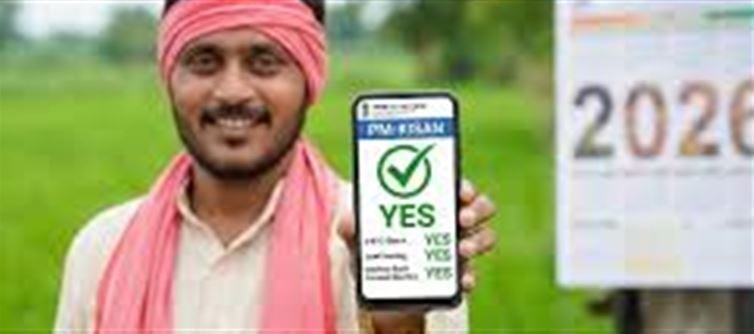

The government has made a big change to the PM Kisan Samman nidhi Yojana rules for 2026. Now, simply completing e‑KYC won’t ensure you get your financial support — you must also have a Farmer ID (a special wallet PLATFORM' target='_blank' title='digital-Latest Updates, Photos, Videos are a click away, CLICK NOW'>digital ID) to continue receiving benefits like the 22nd instalment and future payments. If you don’t complete this requirement, your ₹2,000 instalments may be delayed or even stopped.
1. What’s Changed in PM Kisan Rules?
The government has now made Farmer ID mandatory, in addition to e‑KYC, for farmers who want to receive their PM Kisan instalments in 2026. This new requirement is part of the AgriStack initiative to create a centralized wallet PLATFORM' target='_blank' title='digital-Latest Updates, Photos, Videos are a click away, CLICK NOW'>digital database of farmers across the country.
2. Why e‑KYC Alone Isn’t Enough Anymore
Earlier, proving your identity through e‑KYC (linking your Aadhaar with your mobile number) was sufficient. But now, that’s only the first step. You must also register for a Farmer ID — a unique wallet PLATFORM' target='_blank' title='digital-Latest Updates, Photos, Videos are a click away, CLICK NOW'>digital identity that links your land records, farming details, and personal information so that the benefits reach actual farmers without duplication or fraud.
3. What Is a Farmer ID — And Why It Matters
The Farmer ID (also called Farmer Registry ID) is a digital identity created under the AgriStack project. It connects a farmer’s:
✔ Aadhaar information
✔ Land details (like khata/kheshra numbers)
✔ Crop and farming data
This helps ensure PM Kisan benefits, subsidies for fertilizer and seeds, and other agriculture‑linked schemes are delivered accurately and transparently.
4. How Farmer ID Helps You (Beyond PM Kisan)
Getting this special ID isn’t only about PM Kisan money — it also:
🌾 Makes linking with fertilizer and seed subsidies easier
🌾 Speeds up crop insurance claims
🌾 Simplifies bank loans (like Kisan Credit Card or KCC)
🌾 Reduces the need to submit documents again and again
📍 Essentially, it becomes your all‑in‑one agricultural identity.
5. How to Get Your Farmer ID
You can register for a Farmer ID in two ways:
Online Method
Visit your state’s agriculture portal or the AgriStack website
Complete Aadhaar‑based e‑KYC
Enter your land records (khata/kheshra numbers)
Submit for verification — once approved, your Farmer ID will be generated.
Offline/Special Camps
Many states are running Farmer ID registration camps where you can apply by submitting your Aadhaar, land documents, and mobile number at Common service Centres (CSC) or at local camp sites.
6. Deadline Alert: Act Before Payments Get Stopped!
The new rule is already in effect for the 22nd PM Kisan instalment (expected in early 2026). If your Farmer ID isn’t completed and linked — even if your e‑KYC is done — your ₹2,000 payment could be held up or blocked. Government‑run special camps and online registration are underway to help farmers meet this requirement quickly.
Bottom Line
Don’t rely on e‑KYC alone! Getting your Farmer ID is now a must‑do requirement if you want uninterrupted PM Kisan benefits and other agricultural supports in 2026. Register online or visit a special camp before your next payment instalment arrives — otherwise, you risk losing money that you’re entitled to.
Disclaimer:
The views and opinions expressed in this article are those of the author and do not necessarily reflect the official policy or position of any agency, organization, employer, or company. All information provided is for general informational purposes only. While every effort has been made to ensure accuracy, we make no representations or warranties of any kind, express or implied, about the completeness, reliability, or suitability of the information contained herein. Readers are advised to verify facts and seek professional advice where necessary. Any reliance placed on such information is strictly at the reader’s own risk.
 click and follow Indiaherald WhatsApp channel