



WHEN REALITY OUTPACES REEL
Society often erupts in outrage over fictional portrayals. Titles trend. Hashtags explode. Protests demand bans.
But when reality delivers something far more uncomfortable, the silence is often telling.
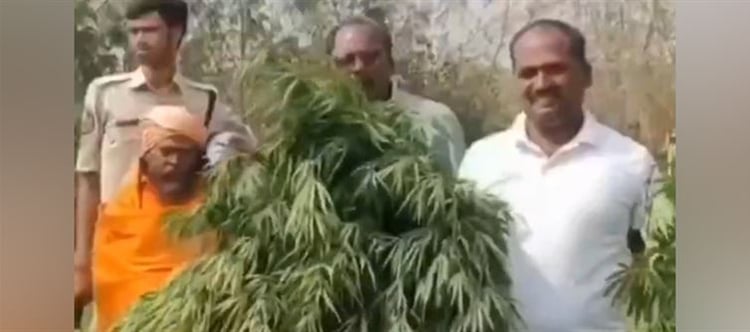
On january 31, 2026, police in telangana arrested a temple priest in sangareddy district after allegedly discovering cannabis worth ₹70 lakh growing inside temple premises.
The accused, identified as Avuti Nagaiah, was reportedly cultivating marijuana plants concealed among marigold flowers.
And suddenly, the debate shifted from cinema to reality.
1️⃣ The Arrest: What Happened
According to telangana police, the cannabis plants were hidden strategically within the temple compound, camouflaged among flower plants typically used for rituals.
The value was estimated at ₹70 lakh.
This was not a minor possession case.
It was alleged cultivation — on sacred property.
Law enforcement acted. An arrest was made. Investigation followed.
That is how the system is supposed to function.
2️⃣ The Contrast: Fiction vs. Fact
Earlier, sections of society expressed anger at a film titled “Ghuskhor Pandat,” arguing that it portrayed priests negatively.
Artistic representation triggered protest.
Yet here is a real case — not scripted, not dramatized — involving alleged illegal activity within a religious institution.
The contrast is stark:
Fiction invites fury.
Reality invites discomfort.
3️⃣ Crime Has No Religious Identity
It is crucial to say this clearly:
An individual’s alleged crime does not represent a religion.
A priest being accused does not implicate all priests.
Illegal activity, if proven, reflects personal misconduct — not faith.
But public reactions often blur this line selectively.
When art shows corruption in religious garb, outrage erupts over “defamation.”
When real corruption appears, the conversation becomes cautious.
Why?
4️⃣ The Bigger Question: What Do We Protect — Faith or Image?
Faith is personal and sacred.
Image is political and public.
If wrongdoing occurs inside a religious institution, confronting it strengthens faith by proving accountability exists.
Ignoring it weakens institutions by shielding misconduct.
Protecting reputation at the cost of truth does not defend religion.
It defends impunity.
5️⃣ The Pattern of Selective Outrage
This case forces an uncomfortable reflection:
Are we quicker to protest art than to demand accountability?
Do we react more strongly to imagined insult than proven illegality?
Is symbolism more powerful than substance?
Outrage should be consistent.
If defamation concerns us, corruption should concern us more.
6️⃣ Law Above All
The most important principle is simple:
The law applies equally — whether the accused is a politician, a businessman, an influencer, or a priest.
If the allegations are substantiated, prosecution must follow.
If innocence is proven, so be it.
But investigation should not be muted because the setting is sacred.
Sacred spaces deserve higher standards, not lower scrutiny.
🎯 THE CORE ISSUE
This incident is not about attacking religion.
It is about confronting hypocrisy.
If we are prepared to protest cinema for fictional portrayals, we must also be prepared to demand accountability when reality presents something far more troubling.
Faith does not weaken when corruption is exposed.
It weakens when corruption is ignored.
And the real test of any society is not how loudly it defends sentiment —
But how firmly it defends truth.
 click and follow Indiaherald WhatsApp channel