


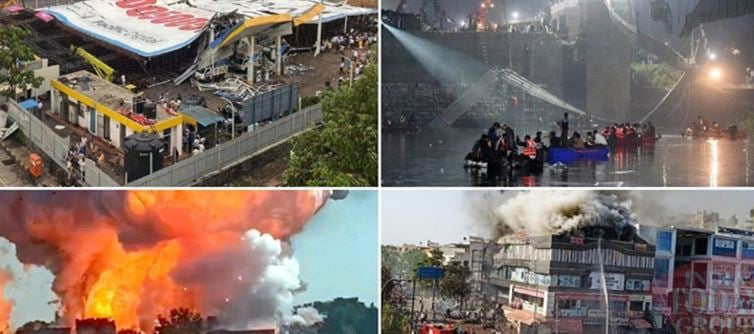

THE cycle WE’VE NORMALIZED
A bridge collapses.
A billboard crashes.
A nightclub burns.
A factory explodes.
A coaching center floods.
People die.
Then comes the announcement: ₹2 lakh. ₹4 lakh. ₹5 lakh.
The cameras roll. The compensation is declared. The outrage trends.
And then — silence.
The most disturbing truth isn’t that these tragedies happen.
It’s that they are no longer shocking.
They are routine.
1️⃣ The Ghatkopar Billboard Collapse — Mumbai, 13 May 2024
A giant hoarding in Mumbai’s Ghatkopar area crashed during a storm, killing 17 people and injuring more than 75.
Investigations pointed to irregular permissions and structural lapses.
Eknath Shinde announced ₹5 lakh ex-gratia for each deceased.
But here’s the uncomfortable question:
If permissions were irregular, who approved them?
And why did the system fail before the structure did?
2️⃣ Morbi Bridge Collapse — Gujarat, 30 october 2022
A pedestrian suspension bridge over the Machchhu River snapped, sending families plunging into the water.
At least 141 people died.
The bridge had reportedly reopened after “renovation” days before the collapse.
Compensation followed. Arrests followed. Headlines followed.
But systemic reform?
Still debatable.
3️⃣ Harda Firecracker Factory Explosion — Madhya Pradesh
A blast ripped through an illegal or poorly regulated unit, killing 13 and injuring over 170.
A state inquiry later termed it a “man-made tragedy.”
Narendra Modi and Mohan Yadav announced financial aid.
But if it was man-made, it was preventable.
And if it was preventable, who failed?
4️⃣ Indore’s Contaminated Water Deaths — 2025
Over 30 reported deaths linked to contaminated drinking water. Thousands allegedly fell ill.
This wasn’t a storm.
This wasn’t fate.
This was infrastructure.
₹2 lakh compensation was announced.
But safe water is not a luxury service. It is governance 101.
5️⃣ surat Coaching Centre fire — 24 May 2019
An illegal coaching centre operating with serious safety violations caught fire. 22 students died.
Children died in a building that shouldn’t have been functioning the way it was.
Compensation was declared.
But illegal structures don’t appear overnight.
They operate openly — until they burn.
6️⃣ Gambhira Bridge Collapse — Gujarat, 9 July 2025
22 dead. Structural failure suspected.
Another bridge. Another set of promises.
Infrastructure audits are often reactive — conducted after collapse, not before.
Why are inspections triggered by funerals?
7️⃣ Indrayani River Bridge Collapse — Pune
An aging bridge reportedly lacking structural audits collapsed, killing four and injuring dozens.
Overcrowding and neglect were cited.
If audits were missing, who skipped them?
And why is enforcement always post-mortem?
8️⃣ Birch Nightclub fire — Goa, 6 december 2025
An illegal nightclub built on a salt pan, operating without licence, caught fire.
25 people died.
The probe later exposed illegal construction.
Illegal. Operating. Publicly.
Until bodies forced attention.
9️⃣ Illegal Coal Mine Explosion — Meghalaya
18 labourers killed in an illegal mine.
Illegal mining is not hidden. It thrives because enforcement is weak or compromised.
Compensation flowed from multiple governments.
But labourers do not enter illegal mines by accident.
They enter because the system allows them to exist.
🔟 kolkata Electrocutions — september 2025
Nine dead due to exposed electrical lines during severe waterlogging.
Poor maintenance was blamed.
Urban infrastructure failures are predictable during monsoon.
Yet every year, they surprise authorities.
1️⃣1️⃣ delhi Coaching Centre Flooding — July 2024
Three civil service aspirants — Shreya Yadav, tanya Soni, Nevin Dalvin — drowned after their coaching centre basement flooded.
Days later, Nilesh Rai, another aspirant, died of electrocution.
These weren’t remote villages. This was the national capital.
If the future bureaucrats of india are unsafe in preparation hubs, what does that say about urban regulation?
The Real Pattern: Disaster → Ex-Gratia → Silence
There is a ritual now:
• Tragedy strikes.
• Compensation is announced.
• Political leaders express grief.
• A probe is ordered.
• Headlines fade.
• Main accused often secure bail.
• Life resumes — until the next collapse.
The taxpayer pays twice.
First through negligence.
Then through compensation.
The Hard Questions No One Answers Clearly
Why are illegal structures allowed to function openly?
Why are audits ignored until collapse?
Why are safety inspections reactive, not preventive?
Why do powerful accused secure freedom quickly?
Why does accountability evaporate after public attention shifts?
Negligence is rarely dramatic.
It is slow.
It is bureaucratic.
It is signed on paper.
And it kills.
⚖️ The Accountability Gap
In many cases, primary accused secure bail. Cases drag for years. Political connections blur responsibility.
Power and wealth often outlast outrage.
And the message becomes dangerous:
There is little fear of consequence.
Until consequences fall on ordinary citizens.
🎯 The Uncomfortable Conclusion
These are not freak accidents.
They are governance failures.
They are inspection failures.
They are enforcement failures.
And they are repeated.
How many more bridges must fall?
How many more children must burn?
How many more students must drown?
How many more workers must explode underground?
Compensation is relief.
It is not justice.
And until accountability becomes routine instead of tragedy becoming routine, this cycle will continue.
Not because we don’t know what’s wrong.
But because those responsible do not fear what will happen if they fail.
 click and follow Indiaherald WhatsApp channel