



THE VIRAL AISLE MOMENT THAT BROKE THE INTERNET
It began like any other day in the self-care aisle — fluorescent lights, soft background music, and a shopper reaching for a blue bottle.
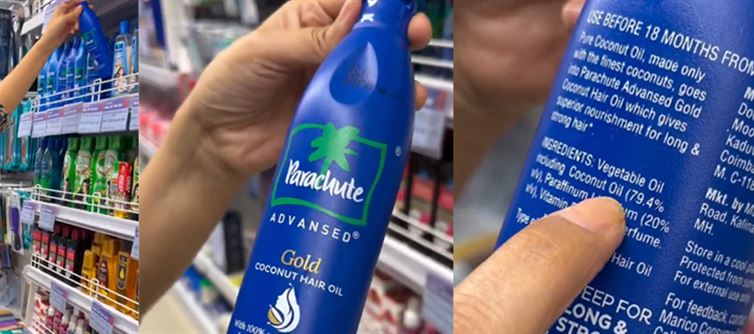
But when a woman in a floral shirt confidently picked up a Parachute Advansed gold Coconut Hair Oil, the internet lost its collective mind.
Why? Because that single act — captured on camera and shared millions of times — exposed one of India’s most quietly deceptive product labels.
It wasn’t just about what she bought.
It was about what the label didn’t say.
🧠 EXPERTS BAFFLED: “SHE CHOSE THE 79.4% VEGETABLE OIL!”
Consumer experts, marketing analysts, and even nutritionists were left in disbelief.
“It’s as if she ignored the glaring truth that the product, despite its golden promise, contains nearly 80% vegetable oil,” one expert said. “Who does that in 2025?”
The so-called ‘100% pure coconut oil’ wasn’t lying — not exactly. But it wasn’t telling the full truth either.
In fine print hidden away from the front label, the ingredients reveal the catch: the product is a non-edible, fortified hair oil where the base oil happens to be coconut — but the rest? A blend of cheaper vegetable derivatives and additives for texture and fragrance.
🧾 THE BIG DIFFERENCE: “WITH 100% PURE COCONUT OIL” ≠ “100% PURE COCONUT OIL”
This is the oldest trick in the advertising playbook — the strategic placement of the word “with.”
“With 100% pure coconut oil” sounds saintly, doesn’t it? It conjures up images of traditional purity, of grandmothers warming oil in steel bowls.
But the phrase actually means the product contains some amount of pure coconut oil, not that it is pure coconut oil.
It’s legal. It’s clever. And it’s devilish.
“This is how brands play by the rules — and still win the game,” says one branding consultant.
“They’re not lying. They’re just letting you fill in the blanks with your nostalgia.”
💄 MARKETING MANIPULATION DISGUISED AS TRUST
For decades, Parachute has built its empire on one word: pure.
The blue bottle became synonymous with trust, simplicity, and tropical nostalgia. So when the company introduced its “Advansed Gold” variant — boasting “100% pure coconut oil base” — few questioned it.
But here’s the truth:
The original Parachute blue bottle is pure, edible coconut oil.
The Advansed Gold variant is not edible — it’s fortified, perfumed, and blended for external use only.
Consumers, conditioned by years of branding, saw “Parachute” and “100% pure” together — and their critical thinking took a backseat.
🧯 DAMAGE CONTROL: “IT’S PURE, JUST NOT EDIBLE”
As the video went viral, the company issued a clarifying statement:
“The base of the hair oil is made using 100% pure coconut oil.”
Which, again, is technically true — but dangerously misleading.
If the product had clearly said “100% pure coconut oil (non-edible/fortified for hair use)” on the front label, none of this chaos would’ve erupted.
Instead, consumers felt tricked by omission — not because the brand lied, but because it let the half-truth shine brighter than the full one.
🧩 THE REALITY CHECK: PURE oil, IMPURE MARKETING
Let’s be clear:
The coconut oil used in the formulation is indeed pure.
But once you mix it with vegetable oil, fragrance, and fortifying agents, it’s no longer 100% coconut oil.
It’s like saying a soft drink is “made from 100% real fruit” — even though 90% of it is sugar water and flavoring.
This is not a food-grade product. It’s cosmetic-grade hair oil, and consuming it can be harmful.
Yet, the packaging doesn’t scream that warning — because why ruin a pretty illusion with hard truth?
🕵️♀️ CONSUMER LESSON: read BEYOND THE BOLD LETTERS
The Parachute Advansed gold saga isn’t just about one brand. It’s a mirror held up to how easily India’s consumers are lulled by packaging poetry.
Every word — “pure,” “natural,” “advanced,” “gold” — is part of a careful orchestra designed to play on your trust.
So the next time a bottle whispers “100% pure”, ask yourself:
Pure what?
Pure where?
Pure for whom?
⚡ FINAL CUT: PURITY IS THE NEW MARKETING POISON
In a market where the label shouts louder than the ingredient list, truth is often found in 6-point font.
The shopper in the floral shirt may have just become a meme, but she’s also a symbol — a reminder that in 2025, consumer literacy is your only defense against corporate semantics.
Because in the end, the oil may shine — but the truth always slips through the cracks.
 click and follow Indiaherald WhatsApp channel