


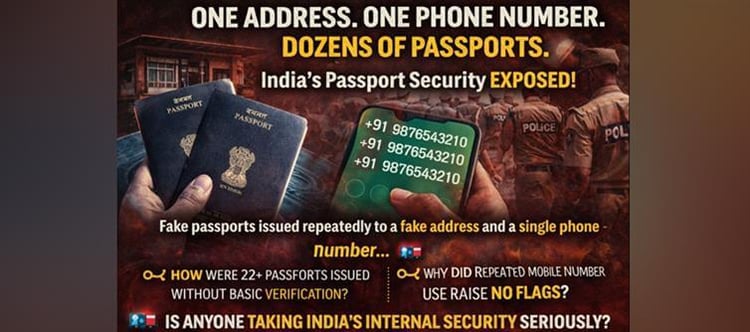

🚨 ONE ADDRESS. ONE phone NUMBER. DOZENS OF PASSPORTS.
How a Tiny Detail Tore Open India’s Passport Security—and Why This Is a National Alarm
The most dangerous failures aren’t loud.
They’re quiet. Repetitive. Ignored.
In Ghaziabad, a fake passport racket collapsed not because of advanced surveillance or elite intelligence—but because someone noticed a pattern so obvious it should have never passed the system in the first place.
The same address.
The same mobile number.
Again and again.
That’s all it took to expose a breach with consequences far bigger than corruption.
We like to believe passports are sacred documents—earned, verified, and secure.
The ghaziabad case shatters that comfort.
Because when 22+ passports can be issued to addresses where nobody lives, using the same mobile number, the problem isn’t a few bad actors.
It’s the system.
🧨 WHAT ACTUALLY HAPPENED
1️⃣ The Simplest red Flag Was Ignored
Multiple passport applications were approved using:
The same residential address
The same mobile number
Any half-functional system should’ve flagged this instantly.
It didn’t.
2️⃣ Addresses That Don’t Exist—People Who Were Never Found
police discovered that the listed addresses were either:
Vacant
Fake
Or linked to no real residents at all
Yet passports—India’s most powerful identity document—were issued anyway.
3️⃣ An Organized Network, Not a Lone Scam
The Ghaziabad Police busted a coordinated network:
5 arrests so far, including a postman
26 people were identified as part of the racket
Multiple FIRs registered
This wasn’t opportunistic fraud.
It was industrial-scale manipulation.
4️⃣ The Postman Angle Changes Everything
A postman isn’t a random recruit.
He’s part of the verification chain—the last-mile trust link between the state and citizens.
When that link breaks, paper verification becomes meaningless.
5️⃣ Physical Verification—In Name Only
The biggest question:
How did police verification reports clear these addresses?
Either:
Verifications were never done
Or they were knowingly falsified
Both scenarios are catastrophic.
6️⃣ The System Didn’t Just Miss—It Enabled
Reusing the same mobile number should have triggered automatic alerts.
Instead, approvals kept coming.
That’s not negligence.
That’s institutional blindness.
7️⃣ This Is a National Security Issue, Not a local Crime
Passports aren’t just travel documents. They enable:
International movement
Banking
SIM cards
Immigration access
Identity laundering
A fake passport doesn’t just lie—it opens doors worldwide.
8️⃣ How Many Fake Passports Are Still Active?
This case was caught by chance.
So the real question is terrifying:
How many weren’t?
9️⃣ ‘Secure on Paper’ Isn’t Secure
Biometrics, portals, apps—none of it matters if:
Verification is compromised
Accountability is missing
red flags are ignored
Security theatre is not security.
🔟 Trust Once Broken Is Hard to Rebuild
Every indian passport holder now has reason to ask:
Is my identity protected—or just processed?
❓ QUESTIONS THE government MUST ANSWER
How were 22+ passports approved on the same address?
Why wasn’t mobile number reuse flagged?
Who signed off on police verification reports?
How deep does this network go?
What safeguards exist to ensure this never happens again?
⚠️ THE UNCOMFORTABLE TRUTH
This isn’t just corruption.
It’s a systemic failure with national consequences.
When fake addresses can produce real passports, internal security becomes optional.
🏁 FINAL WORD
Big scandals often hide behind small oversights.
In ghaziabad, a single address and one phone number were enough to expose a frightening truth:
India’s passport system doesn’t need smarter criminals.
It needs stricter accountability.
Because if identity can be forged this easily, the cost will be paid far beyond one city.
 click and follow Indiaherald WhatsApp channel