



THE SMELL OF AUTHORITARIANISM
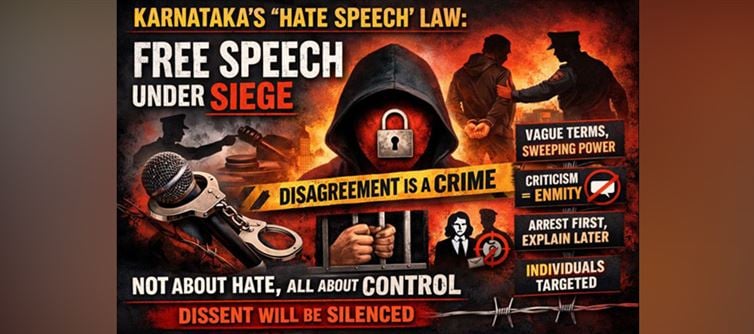
Every authoritarian law begins the same way — wrapped in moral language, sold as protection, justified as necessity. Karnataka’s newly passed so-called “hate speech” bill follows this exact script. On the surface, it claims to curb hatred. In reality, it hands the State a weapon so vague, so elastic, that almost any speech can be twisted into a crime. This is not a safeguard for harmony. It is an instruction manual for suppression — and its consequences will not be theoretical. They will be felt in police stations, courtrooms, and self-censored minds.
1️⃣ A DEFINITION SO BROAD IT SWALLOWS FREE SPEECH WHOLE
The law defines hate speech as any expression intended to cause “injury, disharmony, enmity, hatred or ill-will.” These are not legal standards — they are emotional states. None is objectively defined. None are measurable. None requires proof of harm. When law abandons precision, power replaces principle. A definition this loose does not target hate; it targets inconvenience. It ensures that interpretation, not intent, becomes the crime.
2️⃣ “ILL-WILL” IS NOT A CRIME — BUT THIS LAW MAKES IT ONE
Disagreement by its very nature creates discomfort. Political debate creates friction. Social reform creates disharmony. By criminalising “ill-will,” the law effectively declares that offence equals offence. Saying hijab should not be allowed in schools is a policy position. Opposing reservations, criticising religious practices, questioning government welfare schemes — all of this can “cause ill-will” to someone, somewhere. Democracies survive on disagreement. This law treats disagreement as a threat.
3️⃣ WHEN OPINION IS REBRANDED AS HATRED
Hate speech laws exist to prevent collective harm and violence — not to sterilise public discourse. This bill collapses the crucial distinction between hatred against people and criticism of ideas. Once intent is inferred rather than proven, speech becomes criminal based on perception alone. The result? Political opinion is reduced to prosecutable suspicion.
4️⃣ THE MOST DANGEROUS ADDITION: “INDIVIDUALS.”
Including “individuals” as protected subjects is not a minor tweak — it is a constitutional red flag. Public life runs on criticism of individuals: ministers, judges, activists, clerics, and bureaucrats. Shielding individuals from “ill-will” effectively criminalises scrutiny. Every exposé, every protest slogan, every harsh editorial can now be framed as causing injury or enmity. Power without criticism is not governance — it is control.
5️⃣ SUBJECTIVITY IS NOW THE LAW
Who decides what qualifies as disharmony? A police officer. Who decides intent? An investigating agency. Who decides whether criticism crossed into hatred? The State itself. There is no objective threshold, no requirement of imminent violence, no need for demonstrable harm. The law doesn’t just allow misuse — it invites it.
6️⃣ COGNIZABLE + NON-BAILABLE = PUNISHMENT WITHOUT CONVICTION
This is where the danger becomes operational. A cognizable, non-bailable offence means arrest first, explanation later. Even if acquitted, the damage is done — jail time, legal costs, reputational ruin. The process becomes the punishment. This is not about justice. This is about deterrence. Silence through fear is the real objective.
7️⃣ THE CHILLING EFFECT IS NOT ACCIDENTAL — IT IS THE DESIGN
When citizens cannot predict whether their speech is legal, they self-censor. Journalists soften headlines. Academics avoid controversy. Ordinary people stay quiet. This is how democracies decay — not through bans, but through uncertainty. The law does not need to be enforced often. Its mere existence is enough to suffocate dissent.
8️⃣ history IS CLEAR: VAGUE LAWS NEVER PROTECT FREEDOM
Every misuse-prone law claims good intentions. Sedition did. Emergency rules did. So did countless colonial statutes. The pattern is identical: broad language, moral justification, discretionary enforcement. The result is always the same — power expands, liberty shrinks.
⚠️ FINAL VERDICT: THIS IS NOT ABOUT HATE — IT’S ABOUT CONTROL
If hate speech can mean anything, it will be used against everything. Laws that criminalise feelings rather than actions are incompatible with a free society. Karnataka’s bill does not strengthen democracy — it weakens its spine. A government confident in its legitimacy does not fear words. One that does, writes laws like this.
This isn’t protection.
This is pre-emptive suppression.
And every citizen should be alarmed.
 click and follow Indiaherald WhatsApp channel