
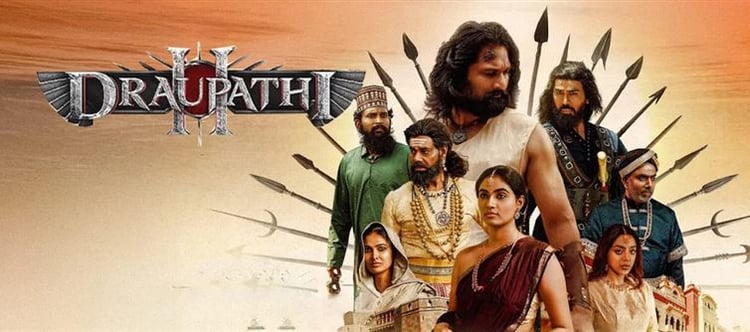


Draupathi 2 Review: Loud Intent, Weak Drama, and a Test of Patience
Story
Director Mohan G, known for choosing controversial socio-political themes, returns with Draupathi 2, the sequel to his most talked-about film. The story begins with Prabhakaran (Richard Rishi), a schoolteacher who has lost his wife and is raising his daughter alone. When someone approaches him seeking help, the narrative gradually shifts into a historical fantasy zone.
A woman arrives claiming responsibility for the maintenance of a village temple, and upon entering it, she transforms into Draupadi from centuries ago, beginning a tale from the perspective of Veera Vallalar. Through his eyes, Kadavarayan (again played by Richard) rises as a protector of the people. The film depicts invasions and atrocities by the Khilji forces in madurai and the arrival of Tughlaq from Delhi, positioning them as brutal oppressors. After Veera Vallalar’s betrayal and death, Kadavarayan takes on the mission of avenging enemies and saving the people. Whether he succeeds forms the rest of the plot.
Performances
Richard Rishi shoulders the film almost entirely, but the writing leaves him little room to emote convincingly. His dual roles fail to register emotionally, largely due to exaggerated dialogue delivery and underwritten character arcs. Most of the supporting cast appears stiff and theatrical, making it difficult to connect with their struggles or pain. Emotional scenes that demand depth end up feeling hollow, as performances rarely transcend surface-level intensity.
Technicalities
Considering the film’s modest budget, the technical aspects are reasonably handled. Cinematography captures the historical and contemporary portions adequately, and the background score does its job of amplifying tension. However, decent visuals and music cannot compensate for the lack of narrative grip. Editing could have been sharper, especially in repetitive and overlong sequences that stretch the viewer's patience.
Analysis
Draupathi 2 attempts to draw from the historical oppression and invasions that tamil society has endured over centuries. While the intent may be to highlight suffering and resistance, the execution becomes problematic when the narrative repeatedly targets a specific community, pushing the film from commentary into discomfort. Instead of balanced storytelling, the screenplay leans heavily on provocative imagery and rhetoric, which overshadows drama and nuance.
Several regressive ideas—such as glorifying caste-based occupations or justifying superstition like delaying childbirth based on astrology—are presented without critique, further weakening the film’s credibility. Even potentially interesting plot devices, like a villain’s allergy to cats being used as a “master plan,” collapse due to poor staging and payoff. What might have worked on paper rarely translates effectively on screen.
What Works
• Decent cinematography and background score
• Attempt to mount a historical narrative on a limited budget
• Clear conviction in the director’s ideological stance
What Doesn’t
• One-note screenplay lacking emotional depth
• Artificial performances and ineffective characterisation
• Repetitive, provocative scenes that replace storytelling
• Logical gaps and poorly executed plot ideas
• Regressive themesare presented uncritically
Bottom Line
Draupathi 2 is heavy on messaging but painfully light on engaging cinema. Despite its strong ideological intent and serviceable technical work, the film struggles to hold attention due to weak writing, forced performances, and a lack of emotional resonance. What could have been a compelling historical drama instead turns into a patience-testing experience.
 click and follow Indiaherald WhatsApp channel