


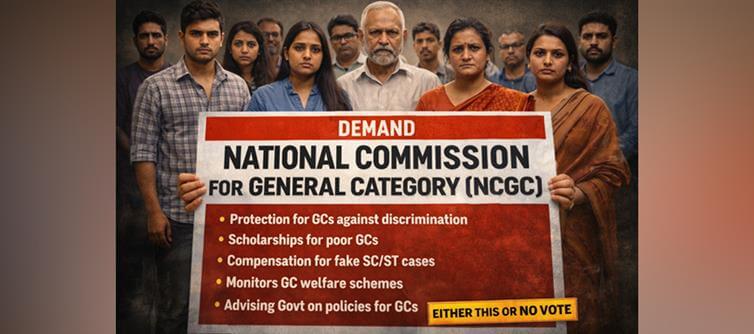

For decades, the General Category (GC) has been told to wait.
Wait for justice.
Wait for reform.
Wait quietly—because asking questions is instantly labeled as entitlement.
But silence has a cost. And today, that cost is visible in discrimination without protection, poverty without scholarships, and legal harassment without recourse. If democracy claims to represent all, then it’s time to ask the uncomfortable question: why does the General Category have no institutional voice at all?
🧨 WHY A NATIONAL COMMISSION FOR GENERAL CATEGORY (NCGC) IS NO LONGER OPTIONAL:
1️⃣ Protection Against Discrimination—Yes, It Exists
Discrimination doesn’t disappear because it’s politically inconvenient. GCs face systemic exclusion in education, jobs, and promotions—but have no constitutional or statutory body to even acknowledge it, let alone address it.
2️⃣ Poverty Doesn’t Check Caste Certificates
Millions of economically weak GC families fall through the cracks because welfare is identity-based, not need-based. Scholarships for poor GCs aren’t a privilege—they’re basic fairness. Hunger doesn’t care about surnames.
3️⃣ Fake Cases Ruin Lives—And No One Is Accountable
False SC/ST cases destroy careers, families, and mental health. Acquittals come years later—if at all. Compensation for proven fake cases isn’t anti-justice; it’s deterrence against legal abuse.
4️⃣ zero Oversight = zero Delivery
Even the few welfare schemes meant for GCs exist only on paper. An NCGC would monitor implementation, expose leakages, and ensure policies don’t quietly die after press releases.
5️⃣ Policy Without Consultation Is Policy Failure
Every major community has a commission that advises the government. GCs have opinions—but no institutional channel to turn them into policy. An NCGC would bring data, dialogue, and accountability to the table.
6️⃣ Equality Cannot Be Selective
If representation is justice, then exclusion is discrimination. You can’t preach equality while denying one group a voice because it’s politically inconvenient.
7️⃣ Silence Has Been Mistaken for Consent
GCs haven’t protested because they believed in the system. That trust has been repaid with neglect. Democracy doesn’t survive on patience alone—it survives on responsiveness.
🧯 THE BOTTOM LINE:
This is not a demand for supremacy.
This is a demand for parity.
If the state can create commissions to protect every group, then denying one to the General Category is not oversight—it’s deliberate exclusion.
So the message is simple, direct, and democratic:
National Commission for General Category (NCGC).
Either representation or no vote.
Because equality that depends on silence is not equality at all.
 click and follow Indiaherald WhatsApp channel