


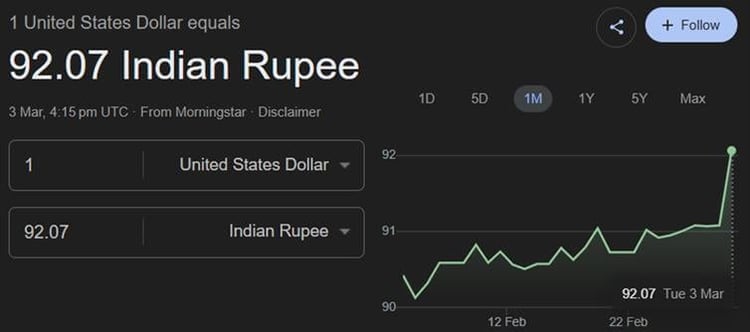

The Rupee at ₹92: A currency Warning Sign
Currencies rarely collapse overnight. They slide gradually, pushed by a mix of global forces, capital flows, and domestic economic choices. Now the indian rupee has crossed a psychological line: ₹92 to the US dollar.
For many economists, the milestone is more than just a number on a trading screen. It’s a signal that multiple pressures — global and domestic — are converging at once.
Some of those pressures are tied to global markets. Others come from structural issues that have been building for years.
Together, they are shaping the rupee’s current trajectory.
1. The Relentless Strength of the US Dollar
One major factor is simply the strength of the US dollar itself.
The Federal Reserve has kept interest rates relatively high as the American economy remains resilient.
Higher interest rates in the united states attract global capital, pulling money into dollar-denominated assets.
When global investors move funds toward the US, emerging-market currencies like the rupee often weaken in response.
2. Billions Leaving indian Markets
Another major pressure point has been the outflow of foreign investment.
Foreign portfolio investors — often referred to as FPIs — have pulled massive amounts of money out of indian equities in recent months.
Estimates suggest over $18 billion has exited indian markets in the recent period.
When foreign investors sell local assets, they convert rupees back into dollars.
That demand for dollars naturally pushes the rupee lower.
3. The Import Problem
India imports enormous quantities of goods, especially oil.
That creates a structural demand for dollars.
Every time indian companies purchase crude oil or other imports, they need to pay in dollars.
When the trade deficit widens, that demand intensifies.
At one point recently, India’s monthly trade deficit touched around $41.7 billion, highlighting how large the gap between imports and exports can become.
And that gap inevitably puts pressure on the currency.
4. Importers Rushing to Hedge
Another dynamic often overlooked is hedging behavior.
When businesses expect the rupee to weaken further, many rush to buy dollars in advance to protect themselves from future price swings.
This defensive move — known as hedging — can actually accelerate the currency’s decline in the short term.
The more companies buy dollars, the higher the dollar climbs.
5. Uncertain Trade Deals and Global Tensions
Trade negotiations with major partners, including the united states, remain uncertain.
Tariffs, shifting trade policies, and geopolitical tensions all influence investor sentiment.
When uncertainty rises, global investors tend to become cautious about emerging markets.
That caution often translates into capital leaving the country — and currency pressure following shortly after.
6. The Role of the Reserve bank of India
The Reserve bank of India has been actively intervening to manage volatility.
By selling dollars from its reserves and adjusting liquidity in the financial system, the central bank attempts to prevent extreme swings in the exchange rate.
India’s large foreign-exchange reserves provide an important buffer.
But even strong reserves can only smooth movements — they cannot permanently resist global market forces.
7. The Long-Term Strength vs Short-Term Pressure Debate
India’s broader economic picture remains complex.
On the one hand, the country has recorded strong growth rates, with GDP expanding around 8 percent in recent periods.
That kind of growth usually supports long-term confidence in a currency.
On the other hand, short-term factors — capital outflows, trade deficits, and global monetary tightening — continue to weigh heavily on the rupee.
The result is a currency caught between strong growth fundamentals and immediate market pressures.
The Bottom Line
The rupee crossing ₹92 per dollar isn’t the result of a single event.
It’s the outcome of many overlapping forces:
• a strong US dollar
• global capital shifting away from emerging markets
• India’s heavy reliance on imports
• trade imbalances and investor uncertainty
For policymakers, the challenge is clear.
Stabilizing the currency requires not just short-term interventions, but also long-term economic strategies that strengthen exports, attract investment, and reduce structural vulnerabilities.
Because in the world of global finance, exchange rates rarely move by accident.
They move because the underlying economic story is changing.
 click and follow Indiaherald WhatsApp channel