


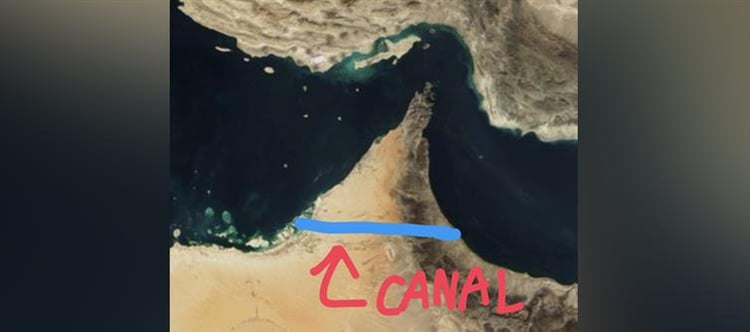

The Canal That Could Change the Balance of Power in the Gulf
The Strait of Hormuz is one of the most strategically important waterways on Earth.
About 20% of the world’s oil supply normally passes through that narrow corridor linking the Persian gulf to the open ocean. When tensions rise there, energy markets panic and governments around the world start calculating worst-case scenarios.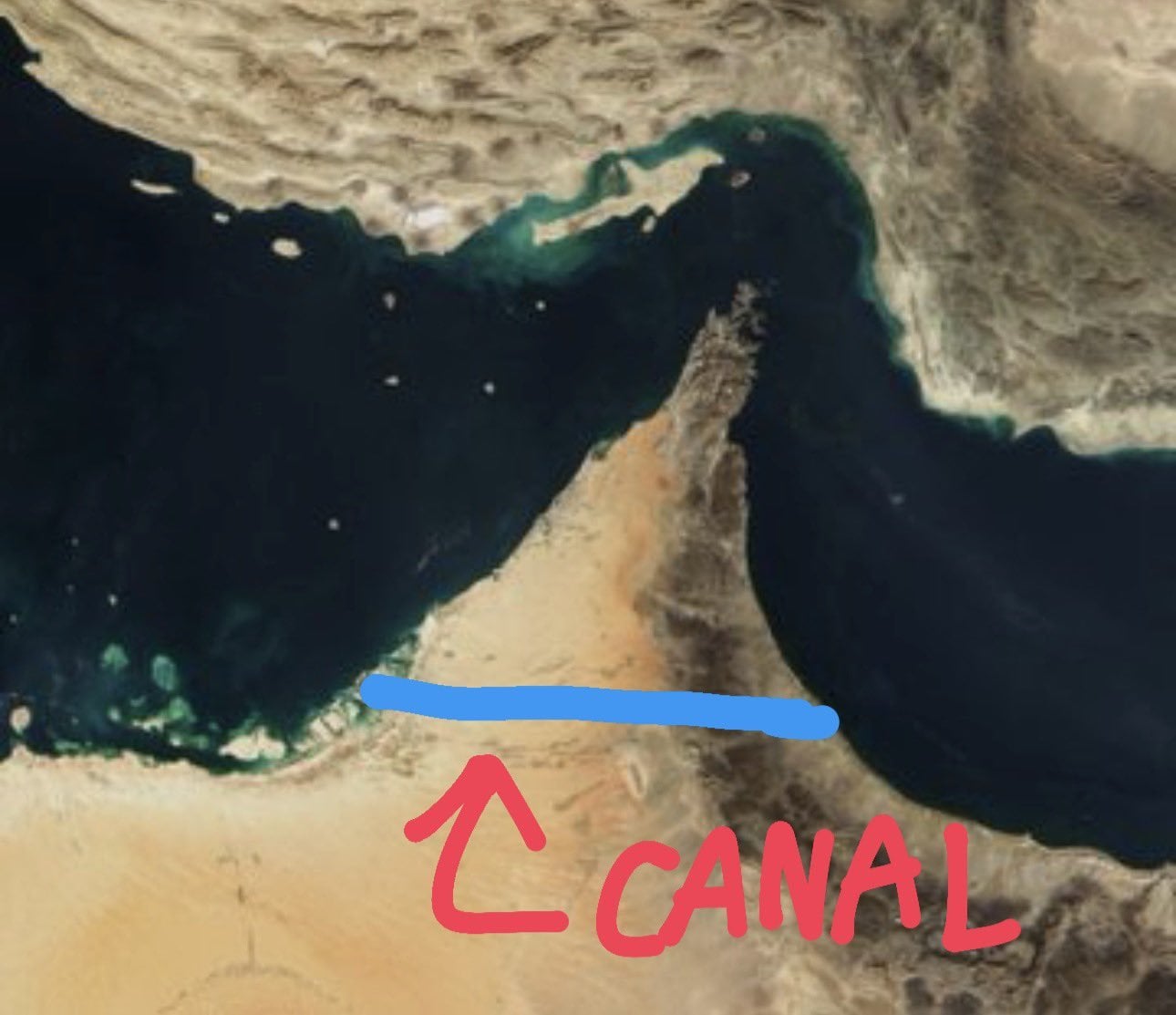
But what if the solution isn’t reopening the Strait at all?
What if the answer is simply building a new route that bypasses it entirely?
It sounds like science fiction — until you look at a map.
Because just a few dozen miles of land separate the Persian gulf from the gulf of Oman.
And that geography has sparked a provocative idea that has floated around policy circles for years: a canal that completely bypasses the Strait of Hormuz.
1. The World’s Most Dangerous oil Bottleneck
The Strait of Hormuz is barely 33 miles wide at its narrowest point.
Yet through that tight corridor flows a staggering share of the planet’s energy supply.
That makes it the ultimate geopolitical chokepoint.
If shipping stops there, oil prices surge, supply chains tighten, and the global economy feels the shock almost instantly.
It’s the reason military planners and energy strategists have worried about Hormuz for decades.
2. The Map That Changes the Conversation
Look at the geography surrounding the Strait, and something becomes obvious.
The land separating the Persian Gulf from the Gulf of Oman is surprisingly narrow in some areas.
In certain places across the United Arab Emirates and Oman, the distance between the two bodies of water is only a few dozen miles.
In theory, that opens the door to a dramatic possibility: dig a canal connecting the two.
Tankers could sail straight from the gulf to the arabian sea without ever passing through Hormuz.
3. A “Second Suez” in the Middle East
The concept isn’t entirely new.
Proposals for a Hormuz bypass canal have surfaced periodically for years.
One ambitious idea once envisioned a project costing around $200 billion, stretching across desert terrain to connect the Persian gulf directly to the open ocean.
In scale and ambition, it would resemble the Suez Canal, one of the most transformative engineering projects in history.
A new canal in the gulf could similarly reshape global shipping.
4. Why Allies Might Support It
The potential route would pass through countries closely aligned with the United States.
If tensions in the region escalate, those nations could see a canal as both an economic opportunity and a strategic safeguard.
Such a project would reduce dependence on a single vulnerable chokepoint and create a permanent alternative route for global energy shipments.
For oil exporters and shipping companies, redundancy is priceless.
5. The Engineering Challenge
Of course, building such a canal would be anything but simple.
The proposed corridor crosses the Hajar Mountains, where elevations can exceed 700 meters.
That means massive excavation, complex lock systems, and enormous infrastructure investments.
The cost would likely run into hundreds of billions of dollars, and construction could take a decade or more.
This is not a quick fix.
It’s a generational megaproject.
6. Why the idea Keeps Returning
Despite the obstacles, the idea never quite disappears.
That’s because the strategic logic is powerful.
As long as the global economy relies heavily on energy flows from the gulf, the Strait of Hormuz will remain a critical vulnerability.
A bypass canal would permanently dilute that vulnerability.
Instead of one chokepoint controlling the flow of oil, the region would suddenly have multiple routes.
In geopolitics, redundancy equals security.
7. Pipelines Are Already a Partial Workaround
In fact, the region has already started experimenting with alternatives.
Pipelines have been built to move crude oil from the Persian gulf to ports outside the Strait.
For example, oil can be transported across the uae to terminals on the gulf of Oman.
But pipelines only move a portion of the region’s output.
A canal capable of handling supertankers would be an entirely different scale of solution.
The Bottom Line
Closing the Strait of Hormuz may create immediate leverage in a crisis.
But geography cuts both ways.
If the world ever decides that one narrow channel is too risky to rely on, it could simply build another route around it.
That would take immense time, money, and political will.
Yet history shows that when global trade routes are threatened, the world often responds with bold engineering solutions.
And if that ever happens in the gulf, the strategic importance of the Strait of Hormuz could change forever.
 click and follow Indiaherald WhatsApp channel