


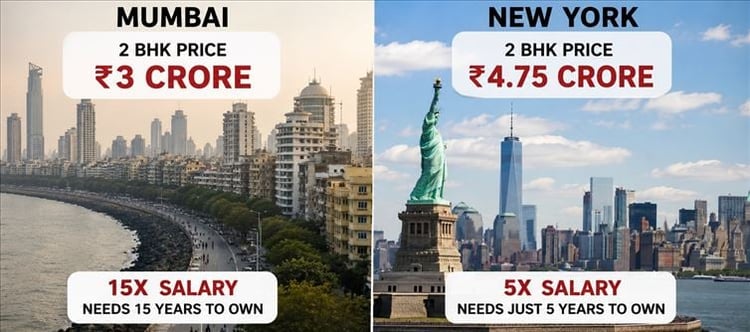

For decades, New York City has been treated as the global symbol of outrageous housing costs — the kind of place where ordinary people supposedly struggle for tiny apartments and impossible mortgages. But a brutal comparison is now exposing just how distorted India’s real-estate market has become, especially in Mumbai.
A typical 2 BHK apartment in mumbai can cost around ₹3 crore. In New York, a comparable apartment may cost roughly ₹4.75 crore. At first glance, that might seem expected. After all, NYC is one of the richest and most expensive cities on Earth.
But the real shock comes when salaries enter the conversation.
In mumbai, the average cost of a decent apartment can amount to nearly 15 times a person’s annual income. In New York, that figure is closer to 5 times the average salary levels. In simple terms, an average worker in NYC can realistically aspire to own property far faster than someone earning a middle-class salary in Mumbai.
That’s where the frustration begins boiling over.
For millions of Indians, buying a home no longer feels like a life goal — it feels like a lifelong debt sentence. Salaries have not remotely kept pace with property inflation, especially in major urban centers. Meanwhile, developers continue targeting luxury buyers, investors, and speculative wealth while ordinary working professionals struggle to afford even modest apartments.
The result is a housing market increasingly detached from economic reality.
Young professionals are delaying marriage, staying with parents longer, taking on massive home loans, or leaving expensive cities entirely because ownership feels mathematically impossible. And despite sky-high prices, many urban residents still deal with overcrowding, poor infrastructure, traffic chaos, water shortages, and inconsistent public services.
That contradiction is what angers people most.
Because when mumbai property prices begin rivaling global mega-cities without matching their income levels, public transport efficiency, or quality of life, the system starts looking less like development — and more like economic imbalance spiraling out of control.
At this point, the question isn’t whether mumbai is expensive.
It’s whether the city is becoming unaffordable for the very people who keep it running.
 click and follow Indiaherald WhatsApp channel