


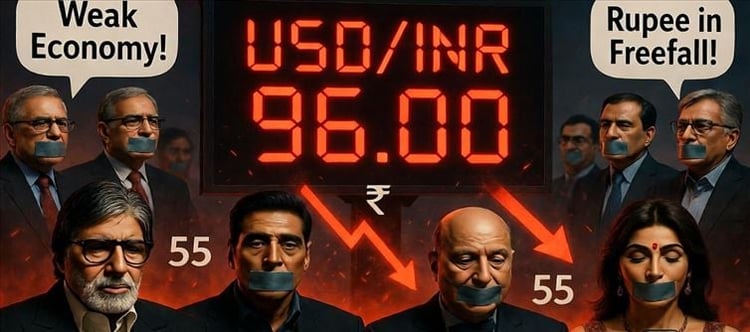

There was a time when the falling rupee was treated like a national emergency in India. television debates exploded. social media campaigns went viral. Celebrities, influencers, and public figures openly mocked the government whenever the currency weakened against the dollar. Back when the rupee touched ₹55 during manmohan Singh’s tenure, outrage was loud, relentless, and deeply political.
Today, the rupee is hovering around ₹96 against the dollar.
And suddenly, many of those same loud voices have gone silent.
That silence is exactly what people are noticing.
Actors and public personalities who once amplified jokes, criticism, and nationalist commentary around currency weakness now appear strangely absent from the conversation. Whether it is amitabh bachchan, Akshay Kumar, Anupam Kher, or Juhi Chawla, critics online are accusing many public figures of selective outrage — vocal when it suited the political mood, invisible when the same issue became inconvenient.
And that frustration is bigger than Bollywood.
Because the rupee falling to these levels is not just symbolic anymore. It directly impacts fuel prices, imported goods, education abroad, travel costs, inflation, industrial inputs, and household purchasing power. Ordinary indians feel currency weakness in their daily lives even if they never track forex charts.
Which is why many people are asking an uncomfortable question: Was the outrage back then truly about economics, or was it mostly political branding?
The internet never forgets old tweets, interviews, slogans, or public mockery. And in the age of social media, selective activism gets exposed faster than ever.
people can tolerate bad news.
What they increasingly struggle to tolerate is visible inconsistency.
Because once public figures position themselves as politically aware voices during one era, complete silence during a similar or worse situation in another era inevitably starts looking less like patriotism — and more like convenience.
 click and follow Indiaherald WhatsApp channel