



⚖️ 47 Vacancies, zero General Seats: A Recruitment Notice That Ignited Debate
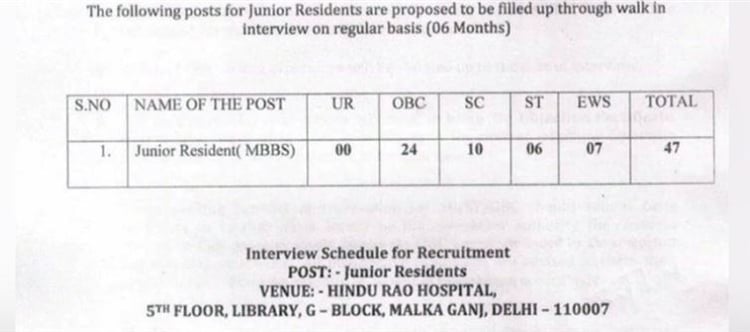
A recruitment notification from Hindu Rao Hospital in delhi has sparked intense debate across social media and policy circles. The hospital announced 47 vacancies for junior Resident (MBBS) posts, with zero seats allocated to the General category.
That single line in the notification triggered outrage, frustration, and renewed calls for a broader conversation on India’s reservation framework.
This is no longer just about one hospital. It’s about how india balances historical justice with contemporary opportunity.
🔥 1. The Core Question: Access or Exclusion?
Critics argue that when all seats in a recruitment cycle are reserved under constitutionally mandated categories, candidates from the unreserved (General) pool effectively lose the opportunity to even compete.
The frustration stems from a simple emotional equation:
Citizenship? Yes.
Taxes paid? Yes.
Voting rights exercised? Yes.
Then why no access to this recruitment cycle?
For many aspirants preparing for government jobs, the perception is not just of competition, but of complete exclusion.
📜 2. The Legal Framework Behind It
India’s reservation system is rooted in constitutional provisions designed to uplift historically marginalized communities. Articles 15(4), 16(4), and related supreme court judgments provide the framework for affirmative action.
In certain recruitment cycles, depending on backlog vacancies, roster systems, and carry-forward rules, it is legally possible for all seats in a particular round to fall under reserved categories.
Supporters argue this is not discrimination, but a correction of a historic imbalance.
Critics argue that when the pendulum swings too far in a single cycle, it creates new perceptions of unfairness.
🎯 3. Merit vs Social Justice: The Eternal Tug of War
This controversy exposes the central tension in India’s public employment policy:
Should opportunity be strictly merit-based in every cycle?
Or should structured equity take precedence until measurable parity is achieved?
For General category aspirants, zero-seat notifications feel like structural denial.
For reserved category candidates, reservations are not a privilege, but long-overdue representation.
The debate isn’t new. But each such notification reignites it.
🏥 4. Why Medical Posts Make It Even More Sensitive
When it comes to medical institutions, emotions run higher.
Healthcare is seen as a merit-driven, high-skill profession. junior Resident posts are stepping stones in medical careers. Missing out on even one recruitment cycle can affect long-term progression.
For MBBS graduates navigating an already hyper-competitive system, every vacancy counts.
That’s why this particular notice struck a nerve.
⚠️ 5. Policy Fatigue and Public Perception
Whether justified legally or not, notifications with zero unreserved seats create perception problems.
Public perception matters.
If large sections of young, educated citizens feel systematically excluded — even temporarily — resentment builds.
That resentment is not necessarily against communities, but against policy design.
And a policy that breeds resentment risks political and social instability.
🔄 6. Is It Time for a Policy Recalibration?
Many policy analysts now argue for:
Greater transparency in roster systems
Clear explanation of backlog calculations
Smoother distribution across recruitment cycles
Periodic socio-economic reassessment of eligibility criteria
The debate is increasingly shifting from “whether” reservations should exist to “how” they should evolve.
Balancing historical justice with present-day fairness is not easy. But silence only deepens polarization.
🧠 The Bigger Question
India’s reservation system was never meant to be static. It was designed as a dynamic tool for social transformation.
But transformation requires periodic review.
When recruitment notices trigger widespread frustration, it signals not necessarily that the constitutional vision is flawed — but that implementation and communication may need serious refinement.
🔥 Final Word
The Hindu Rao Hospital recruitment notice is not just about 47 junior Resident posts.
It is about:
Trust in public institutions
Perceptions of fairness
The future of affirmative action policy
And the aspirations of millions competing for limited opportunities
In a democracy, difficult questions must be asked — not to divide, but to refine.
The conversation must move beyond outrage.
It must move toward reform.
 click and follow Indiaherald WhatsApp channel