



🔥A Sacred festival Now Caught Between Law, Power & A Stunning Judicial Command
Karthigai Deepam should have been about devotion.
Instead, it has detonated into one of tamil Nadu’s most heated constitutional showdowns.
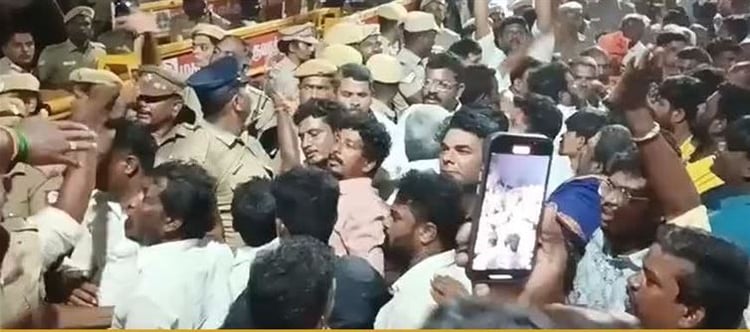
A judge’s extraordinary order, a controversial activist at the centre, a central force pushed into a state law-and-order dispute, and the tamil Nadu government flatly refusing to bend — tamil Nadu is watching an unprecedented clash of institutions play out in real time.
And in the eye of the storm stands one burning question:
How did a habitual offender end up receiving CISF protection on judicial orders?
⚡Law & Order Is A State Subject — And DMK Stood Firm
No ambiguity.
No hesitation.
The DMK government made its position clear:
Law & order in tamil Nadu is governed by the state — not the judiciary, not the Centre, not fringe groups.
So when the Hindu Munnani group demanded permission to light the Karthigai Deepam near the Muslim dargah — a location never used traditionally — the state denied it.
Their reasoning:
Prevent communal tension. Preserve the decades-old practice. Maintain public peace.
And history proved them right, because the Deepam was ultimately lit exactly at the traditional spot, just like every single year.
🔥 Justice G.R. Swaminathan’s Order — A Move That Shocked Legal Circles
Then came the judicial thunderbolt.
Justice G.R. swaminathan issued an order allowing the Hindu Munnani group to light the Deepam near the dargah — a location the state had already flagged as sensitive.
But the shockwave came not from the permission.
It came from the next step:
He directed CISF protection for the group.
A direction that instantly raised eyebrows across constitutional experts, bureaucrats, and law-and-order officials.
Because the CISF is not a district police force.
It is a central armed force with a specialised mandate, far removed from local religious disputes.
⚠️CISF’s Actual Mandate — Courts, Airports, Harbours… Not Religious Flashpoints
The CISF exists for:
security of airports
defence-related industries
nuclear installations
metros
government buildings
protection of judges within court premises
What it does not do:
provide security for state-level religious protests
escort fringe groups in sensitive communal zones
intervene in a location already deemed sensitive by state intelligence
Yet suddenly, a force meant to guard airports and reactors was thrust into a religious confrontation zone.
The contradiction is glaring.
The legality? Hotly debated.
The optics? Explosive.
💥The Explosive Question — CISF Protection For A Habitual Offender?
And then comes the name that escalated the controversy to an entirely different level:
Rama Ravikumar.
A man with a long record of repeated offences.
A habitual defaulter of law and order.
A person whose actions have frequently triggered tension on the ground.
How could a central paramilitary force — one that guards airports and judges — be ordered to protect someone with such a history?
This is the question reverberating across tamil Nadu.
Legal experts are calling it “unprecedented.”
Political observers call it “dangerous.”
Civil society calls it “deeply alarming.”
Because this isn’t simply about a flame.
It’s about giving institutional legitimacy to repeated offenders under the shield of central protection.
And that’s a line tamil Nadu has never crossed before.
🔥A festival Hijacked — And A Larger Attempt To Polarise?
The ground reality is clear:
The Deepam was lit peacefully at the traditional spot.
There was no issue.
No conflict.
No interference.
So why force a parallel Deepam near the dargah?
Why drag the CISF into a local religious matter?
Why elevate a known troublemaker into the spotlight?
For many, the motive looks unmistakable:
Create friction. Feed communal narratives. Manufacture tension in Madurai.
But tamil Nadu has seen through these tactics before — and it is seeing through them again.
🔥What Happens Now? Institutional Conflict Or Correction?
The Karthigai Deepam controversy has now become:
a constitutional question
a law-and-order question
a judicial overreach question
and a communal tension strategy question
The DMK government is standing its ground.
Legal experts are challenging the feasibility of the CISF order.
Civil society is questioning the ethics of protecting a repeat offender.
The next few days will decide whether this becomes:
a rare correction,
ora landmark conflict between state power and judicial activism.
But one thing is certain — the festival flame has sparked a political and constitutional debate that will burn long after the oil in the lamp has run out.
 click and follow Indiaherald WhatsApp channel